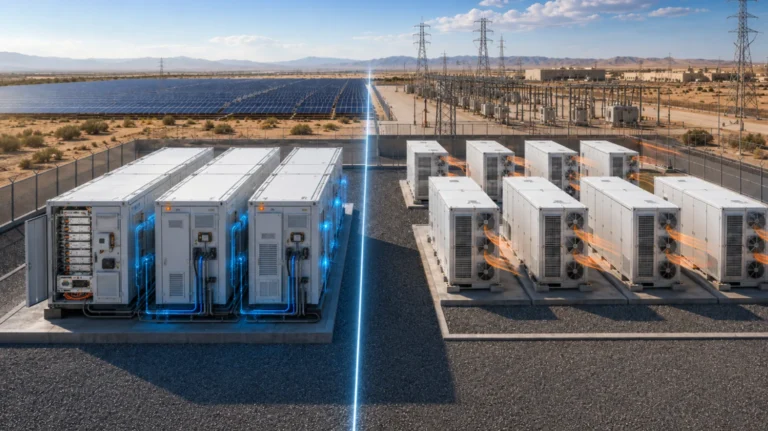
| Decision Factor | Liquid Cooling BESS | Air Cooling BESS |
| Initial Equipment Cost | Usually higher due to additional cooling components such as pumps, coolant loops, and thermal management systems | Usually lower because of simpler HVAC-based thermal management architecture |
| Energy Density | Higher energy density can allow more battery capacity within a smaller footprint | Generally lower energy density may require more cabinets for the same MWh capacity |
| Installation Space | Requires less space, making it suitable for factories, industrial parks, and projects with limited land availability | Requires more installation area due to additional cabinets, airflow requirements, and equipment spacing |
| Number of Battery Cabinets | Potentially fewer cabinets for the same energy-storage capacity depending on product design | Potentially more cabinets required to achieve the same MWh capacity |
| Thermal Management Performance | Provides closer temperature control around battery modules and better temperature consistency | Relies on airflow and HVAC systems, making thermal performance more dependent on enclosure design |
| High Temperature Applications | Generally provides stronger thermal-management capability for demanding environments | Requires careful HVAC design, especially in hot climates and high ambient temperature regions |
| Maintenance Requirements | Requires more specialized maintenance for pumps, coolant systems, and leak monitoring | Easier for technicians familiar with conventional HVAC and ventilation systems |
| Suitable Project Type | Space-limited, high-cycling, high-density commercial and industrial energy-storage projects | Cost-sensitive projects with sufficient land and moderate operating requirements |
| Project Cost Consideration | Higher equipment CAPEX but may reduce land, civil construction, and installation complexity | Lower equipment CAPEX but may increase footprint, foundations, cabling, and construction requirements |
| Best Selection Approach | Choose when lifecycle performance, compact design, and operational efficiency create greater value | Choose when initial budget, simplicity, and available installation space are the main priorities |
When planning a large-scale battery energy storage system (BESS), the choice between liquid cooling and air cooling is becoming an increasingly important design decision. However, based on my experience working with energy-storage projects, I have found that this decision is not simply about choosing a more advanced cooling technology. The real question is how the cooling system will influence the entire project, including equipment quantity, installation space, investment cost, maintenance requirements, and long-term system performance.
Liquid cooling and air cooling are two common thermal-management approaches for BESS projects. Liquid-cooled systems usually provide higher energy density, better temperature consistency, and smaller installation footprints, while air-cooled systems typically offer lower upfront costs and simpler maintenance. The right choice depends on project capacity, available land, operating conditions, climate, budget, and long-term lifecycle requirements.
For a 20MWh energy storage project, the difference between liquid-cooled and air-cooled solutions can become significant. The same storage capacity does not always require the same system configuration. Depending on battery architecture and energy density, one solution may achieve the required capacity with fewer high-density liquid-cooled cabinets, while another may require more air-cooled units with a larger footprint.
What Is Really Happening Behind the Search for Liquid Cooling vs Air Cooling BESS?
When people search for “liquid cooling vs air cooling BESS,” the question often looks technical on the surface, but in real commercial energy storage projects it usually appears much later in the decision process. The user may already have a factory, industrial park, commercial facility, or another project with a defined storage target, operating requirement, installation site, and preliminary budget. At that stage, the concern is no longer simply how liquid cooling works or whether air cooling is cheaper. The real question is how each cooling architecture changes the entire project, including equipment quantity, installation footprint, civil work, cable routing, maintenance requirements, and long-term cost. This is why I see the search intent as much closer to project evaluation and commercial energy storage solutions rather than basic technical research.
The Search Usually Starts With a Real Project, Not a Cooling Question
In most real cases, an EPC contractor or energy solution company does not begin a project by asking whether liquid cooling or air cooling is better. The conversation usually starts with an end customer who already has a power problem to solve. It may be a factory trying to reduce diesel generator dependence, an industrial park planning energy storage for peak shaving, or a commercial facility looking for more stable power.By the time cooling technology becomes part of the discussion, the project team may already know the target capacity, such as 10MWh or 20MWh, the expected charging and discharging pattern, the available installation area, the basic site conditions, and the approximate investment range. Only when the system configuration starts to take shape does the cooling question become important.
This is where the internal project discussion often changes from “How much storage do we need?” to “Which system architecture gives us the better overall result?” A lower-cost air-cooled solution can make the initial quotation more competitive, which is attractive when the project owner is highly sensitive to upfront investment. A liquid-cooled solution may require more capital at the equipment level, but it can offer higher energy density, tighter thermal management, and a smaller installation footprint. For a project team, that means the comparison is not simply between two cooling technologies. It is a comparison between two different ways of building and delivering the same energy storage requirement.
That is also why broad statements such as “liquid cooling is more efficient” or “air cooling is cheaper” are not enough for an EPC preparing a real proposal. The value comes from understanding what those differences mean at the project level. A lower equipment price can be offset by a larger site requirement, while a higher equipment price can sometimes be justified if it reduces cabinet quantity, construction work, or space pressure. The search behind “liquid cooling vs air cooling BESS” is therefore often a sign that the user is already in the commercial investigation stage and needs information that can support an actual engineering and purchasing decision.
Why the Same 20MWh Requirement Can Produce Very Different Equipment Quantities
One of the most important things I have seen in large BESS discussions is that the same total storage requirement does not necessarily result in the same number of battery units. A customer may simply say that the project needs 20MWh, but that figure only describes the target energy capacity. It does not determine how many cabinets or containers will be required to achieve it. The final quantity depends on the product architecture being compared, including battery cell capacity, internal module arrangement, energy density, thermal management design, and the usable capacity of each cabinet or container. This means that two suppliers can both propose a 20MWh solution while presenting very different physical layouts.
In one 20MWh project discussion we encountered, the preliminary comparison resulted in approximately four higher-density liquid-cooled units versus around ten air-cooled units. That four-versus-ten relationship should not be treated as a universal rule for every 20MWh project, because it came from the specific products and configurations being evaluated in that case. What made the comparison valuable was not the ratio itself, but what happened to the project once the equipment quantity changed so significantly. The conversation immediately moved beyond cooling technology and into questions about how much land would be required, how many foundations might be needed, how the equipment would be arranged, how much cable routing would be involved, and how maintenance teams would access the system over its operating life.
The larger number of air-cooled units can create a broader project footprint because more equipment must be positioned with sufficient clearance for ventilation, operation, and maintenance. If the customer already owns a large amount of low-cost land, this may not be a major disadvantage, and the lower initial equipment cost of air cooling can remain very attractive. However, on a constrained industrial site, where space is already occupied by production buildings, transformers, generators, roads, or future expansion areas, the footprint difference can become a meaningful commercial factor. In that situation, the higher energy density of a liquid-cooled configuration may have value beyond thermal performance because it allows more storage capacity to be installed within a smaller usable area.
Equipment quantity also affects civil construction and electrical installation. More cabinets can mean more concrete bases, anchoring points, cable trenches, communication connections, access paths, and site preparation. These costs are easy to overlook when a buyer compares only the unit price of the battery cabinets, but they become important when the EPC calculates the fully installed project cost. The same applies to cable routing. A greater number of units generally creates more power connections, more communication lines, more cable runs, and more points that must be installed, tested, and commissioned. Ten units do not automatically mean that installation costs will be two and a half times those of four units, but the number of physical interfaces increases, and that usually means more engineering and installation work.
Maintenance access creates another practical difference. A BESS site has to work not only on the day it is commissioned but throughout years of operation. Technicians need enough space to inspect HVAC systems, liquid cooling components, electrical panels, communication hardware, battery modules, and safety equipment. A larger number of units can require a more spread-out service layout, while a more compact higher-density system can reduce the total site footprint but may demand more specialized maintenance capability. This is why the decision cannot be reduced to the simple idea that air cooling is cheaper or liquid cooling is more advanced.
The more useful way to look at the comparison is to separate equipment cost from total project cost. Air cooling can reduce upfront equipment investment, but if the chosen architecture requires more cabinets, more land, more foundations, and more cabling, some of that saving may be absorbed elsewhere in the project. Liquid cooling can increase equipment cost, but its higher energy density may reduce space pressure and simplify the physical layout. Neither outcome is automatically better. The right choice depends on the site, the operating profile, the local climate, the maintenance environment, and how the customer values initial investment versus long-term system performance.
For me, this is the real industry issue behind the search. “Liquid cooling vs air cooling BESS” looks like a cooling comparison, but for a 20MWh project it is actually a system architecture question. The important decision is not simply which technology removes heat more effectively, but which configuration gives the project the most reasonable balance between equipment investment, available space, construction requirements, installation complexity, maintenance capability, and lifecycle economics.
Why Cooling Technology Matters More as BESS Capacity Increases
As BESS projects move from hundreds of kilowatt-hours into multi-megawatt-hour and tens-of-megawatt-hour installations, cooling stops being a secondary equipment feature and becomes part of the system design itself. I look at thermal management in the same way I look at PCS sizing, battery capacity, or EMS strategy: it influences how reliably the system can deliver its rated performance over time. A larger battery system contains more cells, more modules, and more concentrated energy, so even relatively small temperature differences can be repeated across thousands of cells. The real concern is therefore not simply whether the system stays within a safe temperature range, but whether it can maintain consistent charging and discharging performance, control degradation, preserve usable capacity, and avoid excessive cooling-related energy consumption throughout the project lifetime.
Battery Temperature Affects More Than Safety
Battery temperature is often discussed mainly from a safety perspective, but in a commercial BESS project I see it as a much broader performance and economic issue. The cells inside a battery system do not operate independently. Their performance depends on how consistently temperature is controlled across modules and racks. If some cells regularly operate hotter than others, they can age at a different rate, which gradually increases imbalance within the battery system. That imbalance may not create an immediate failure, but over years of operation it can affect how much of the installed capacity the system can actually use and how consistently the BESS can meet the performance expected in the original project design.
Charging and discharging performance is also closely connected to temperature control. A battery system may be designed for peak shaving, solar energy shifting, diesel reduction, or daily load management, but those applications depend on the system being able to charge and discharge repeatedly without excessive thermal stress. If temperatures rise too quickly under high load, the control system may need to reduce charging or discharging power to protect the batteries. From an EPC perspective, that means a project can technically have the required MW and MWh on paper while still delivering less practical performance during demanding operating periods. This is why I do not evaluate cooling only by asking whether it can prevent overheating. I want to understand whether the thermal system can support the duty cycle the customer is actually paying for.
Battery degradation makes this even more important. Every BESS project is built around an expected operating life, and the financial model usually assumes that usable capacity will remain within an acceptable range for many years. Poor temperature uniformity can accelerate uneven aging, which can gradually reduce the usable energy available from the system and make balancing more difficult. Once that happens, the commercial impact appears in several forms: the customer may have less storage capacity available for peak shaving, fewer hours of backup, or a shorter period before battery augmentation or replacement becomes necessary. In a large project, even a relatively small loss of usable capacity can have a meaningful impact because it is multiplied across many megawatt-hours.
Auxiliary power consumption is another factor I pay attention to because cooling itself consumes energy. Fans, HVAC equipment, pumps, control systems, and other thermal-management components all draw power from the system. A cooling design that requires high auxiliary consumption can reduce the net energy available to the customer and affect round-trip system economics. This is particularly relevant in hot climates, where cooling equipment may operate for long periods even when the battery itself is not under maximum load. The difference may look small when reviewing a single cabinet, but across a large BESS and several years of operation, auxiliary energy becomes part of the real operating cost.
For that reason, the most useful question for an EPC is not simply, “What temperature can this battery tolerate?” The better question is, “How will the thermal-management system affect usable capacity, cycling performance, efficiency, degradation, and maintenance over the project lifetime?” That is where cooling technology moves from being a technical specification to becoming part of the business case for the entire storage project.
Large Battery Systems Create More Difficult Thermal Management Conditions
The cooling challenge becomes more complicated as BESS capacity increases because larger systems are not just smaller systems repeated several times. Modern battery products continue to move toward higher energy density, which means manufacturers are packaging more capacity into the same or a smaller physical footprint. From a project perspective, this is attractive because fewer cabinets can reduce land use and simplify the site layout. From a thermal-management perspective, however, higher energy density means more heat is concentrated within the same enclosure, so the cooling system has less margin for uneven airflow or weak temperature control.
The number of cells and modules also matters. In a multi-MWh system, the thermal-management system must maintain acceptable operating conditions across a very large population of battery cells. A small temperature difference between two modules may not appear significant when looking at one cabinet, but when that difference is repeated across many racks and containers, it can contribute to uneven aging across the system. The larger the installation becomes, the more important consistency becomes because the project is only as strong as the ability of all those cells and modules to operate together over time.
Repeated daily cycling adds another layer of difficulty. A BESS used only for emergency backup may remain idle for long periods, while a commercial system used for solar shifting, peak shaving, or diesel reduction may charge and discharge every day. Frequent cycling means heat is generated again and again, so the cooling system must manage a recurring thermal load rather than a rare event. In these applications, I pay much more attention to cooling performance because the thermal system is directly supporting the business model. If the BESS cannot maintain stable operation under repeated cycling, the customer may lose part of the economic value they expected from the project.
Outdoor containerized installations make site conditions part of the cooling calculation as well. Many large BESS projects are installed outside factories, industrial facilities, commercial sites, or remote energy projects, where the equipment has to deal with ambient temperature, dust, humidity, and seasonal weather changes. In a controlled indoor environment, thermal conditions are easier to manage. In an outdoor installation, the cooling system has to compensate for whatever the site gives it. That is why a BESS configuration that performs well in a moderate climate cannot automatically be assumed to perform the same way in a hotter region.
High ambient temperature is particularly important for the markets where many commercial storage projects are being developed. When the air surrounding the equipment is already hot, an air-cooled system has less temperature difference available to reject heat, while any cooling technology may need to operate harder to maintain the battery within its target range. This does not mean that every hot-climate project must use liquid cooling, but it does mean the cooling architecture needs to be evaluated together with the expected ambient temperature, duty cycle, cabinet density, and available installation space rather than selected only on purchase price.
This is why cooling design becomes increasingly important as BESS capacity grows. In a small system, thermal-management differences may have a limited commercial impact. In a 10MWh, 20MWh, or larger project, the same difference can influence how many cabinets are needed, how much auxiliary power the system consumes, how consistently the batteries age, and how much usable energy remains available over time. At that scale, cooling technology is no longer simply part of the cabinet specification; it becomes one of the engineering decisions that can shape the long-term performance and economics of the entire project.
How Liquid-Cooled BESS Works
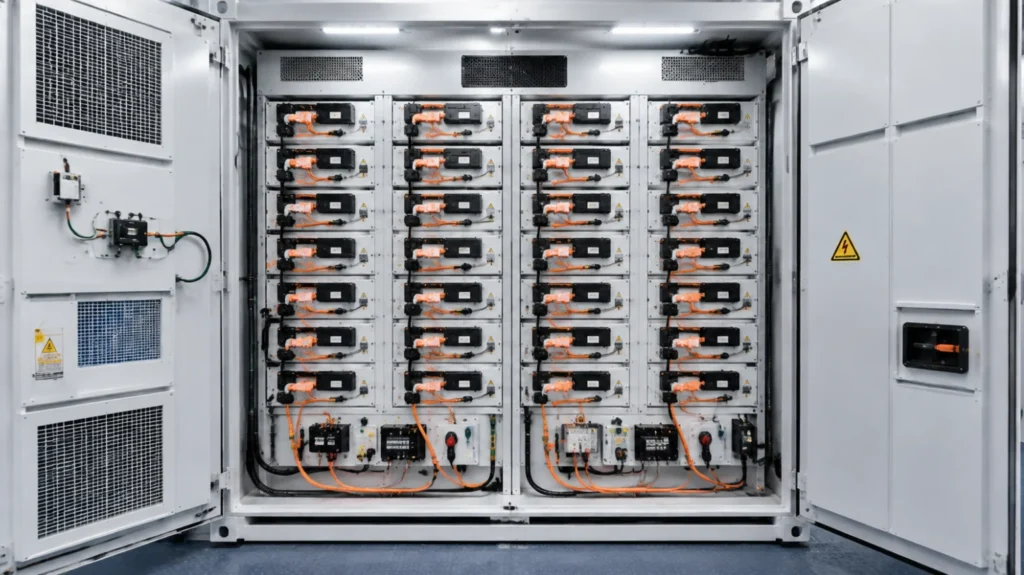
Liquid cooling becomes easier to understand when I look at it from the project level rather than as a collection of individual components. The basic idea is straightforward: instead of depending mainly on air moving through the enclosure to remove heat, a liquid-cooled BESS brings the thermal-management system much closer to the battery modules themselves. That allows heat to be captured and transferred more directly, which is why liquid cooling is increasingly used in higher-density commercial and industrial energy storage systems. The technology is not valuable simply because liquid can move heat effectively; its real value comes from what that thermal architecture allows the overall battery system to do in terms of density, footprint, consistency, and long-term operation.
Basic Liquid Cooling Architecture
A liquid-cooled BESS normally uses a closed coolant loop that circulates through cooling plates or channels positioned close to the battery modules. As the battery cells generate heat during charging and discharging, the coolant absorbs that heat and carries it away from the battery area. A pump keeps the coolant moving through the circuit, while a heat exchanger transfers the collected heat out of the system. The thermal control system then adjusts the circulation and cooling operation according to battery temperature, load conditions, and other system inputs.
I find it more useful to think of this as a controlled heat-transfer path rather than a complicated mechanical system. In an air-cooled cabinet, heat has to move from the cells into the surrounding air and then be carried away by fans and HVAC airflow. In a liquid-cooled system, the thermal path is shorter and more direct because the cooling plates or channels sit much closer to the heat source. This does not eliminate the need for sensors, controls, or external heat rejection, but it gives the system more precise control over where heat is removed and how quickly it is transferred away from the battery modules.
That difference becomes important in large BESS projects because the cooling system is not only reacting to a single hot spot. It has to manage temperature across a large number of cells and modules operating together. The thermal control system continuously responds to changing battery conditions, and the goal is to keep the battery pack within a more consistent operating range instead of allowing large temperature differences to develop between modules. For an EPC or system integrator, that means the cooling architecture directly influences how stable the battery system can remain under repeated charging and discharging.
Why Liquid Cooling Allows Higher Energy Density
One of the main reasons liquid cooling is used in newer high-capacity BESS products is that it changes how much internal space has to be reserved for thermal management. Air-cooled systems need sufficient airflow around battery modules, along with ventilation passages and enough internal space for air to move effectively through the enclosure. Those airflow requirements take up physical room that cannot be used for additional battery capacity.
Liquid cooling reduces that dependence on large airflow channels because heat is carried through dedicated cooling plates or liquid channels instead of relying primarily on air circulation between modules. This gives manufacturers more flexibility to arrange battery modules closer together while still maintaining controlled thermal conditions. The result is that more energy can often be packaged into the same cabinet or container footprint.
From a project perspective, this is where energy density becomes commercially meaningful. Higher energy density does not simply look better on a technical data sheet. It can mean that a 10MWh or 20MWh system requires fewer cabinets or containers to reach the target capacity. In the 20MWh project comparison I discussed earlier, this difference became very visible because the higher-density liquid-cooled configuration required far fewer units than the air-cooled alternative being evaluated. That specific ratio was project-dependent, but the underlying principle is important: when more MWh can be installed per unit of physical space, the entire site layout can change.
Fewer units can reduce the amount of land required for the BESS area and may also simplify foundation planning, cable routing, communication connections, and maintenance access. This is why I do not view higher energy density as only a battery specification. In a large project, it can become a civil-design and installation advantage, especially when the project site has limited available space or when future expansion needs to be considered from the beginning.
Where Liquid Cooling Creates Value in Large Projects
The strongest value of liquid cooling usually appears when several project conditions come together. Tighter temperature consistency is one of the first advantages because the cooling system can manage heat closer to the battery modules and reduce the temperature differences that may otherwise develop across racks or cabinets. For a large system, this matters because more uniform temperature conditions can support more consistent battery behavior over time rather than allowing some modules to operate hotter and age faster than others.
Higher energy density creates another clear project advantage. When a large BESS can deliver the required capacity with fewer cabinets, the customer can use less land for the energy storage area and potentially simplify the overall site layout. This becomes especially important at factories, industrial parks, mining sites, or commercial facilities where available space may already be shared with transformers, generators, production buildings, access roads, or future expansion areas. In these environments, a more compact BESS configuration can create real economic value even if the equipment itself has a higher purchase price.
Liquid cooling also becomes more attractive in high-utilization applications. A BESS used for daily peak shaving, solar energy shifting, renewable integration, or diesel reduction may charge and discharge repeatedly, creating a more continuous thermal load than a system used only for emergency backup. In these cases, I would pay more attention to how consistently the cooling system can support the battery during repeated operation, because the project economics depend on the battery being available and capable of delivering its expected performance day after day.
Hot operating environments strengthen that argument further. In regions where ambient temperatures remain high for long periods, thermal management has to work harder regardless of the technology used. Liquid cooling can provide more controlled heat removal at the battery-module level, which can be useful when the system is both high-density and heavily utilized. I would still avoid saying that every hot-climate project automatically requires liquid cooling, because site conditions, duty cycle, cabinet design, and maintenance capability all matter. However, as project scale and thermal load increase, the value of tighter temperature control becomes increasingly difficult to ignore.
What Buyers Should Not Ignore About Liquid Cooling
The main risk in discussing liquid cooling is making it sound like a technically superior solution with no trade-offs. I do not think that is a useful way to evaluate it. The same architecture that improves thermal control also introduces more components and more maintenance responsibilities. Pumps, coolant lines, valves, heat exchangers, sensors, and control systems all become part of the thermal-management chain, and each of these components needs to operate reliably over the life of the project.
The initial equipment cost is usually one of the first differences buyers notice. A liquid-cooled BESS can require a higher upfront investment because the thermal-management system is more complex than a conventional air-cooled design. For a customer focused heavily on initial CAPEX, that can be a significant concern, especially when an air-cooled alternative can meet the technical requirements at a lower equipment price.
Maintenance also needs to be considered realistically. Liquid cooling requires attention to coolant condition, pump operation, system pressure, leak detection, and the integrity of the cooling loop. Depending on the product design and service plan, coolant inspection or replacement may become part of long-term maintenance. These requirements are not necessarily difficult when a proper service system is in place, but they do mean that local technical capability and spare-parts support should be considered before the technology is selected.
Leak detection is another area that should not be ignored. Modern liquid-cooled BESS products are designed with monitoring and protection measures, but any liquid-based system introduces a failure mode that does not exist in the same way in a simple air-cooled architecture. For an EPC, this is not a reason to avoid liquid cooling, but it is a reason to understand the supplier’s cooling-loop design, monitoring strategy, maintenance procedures, and service responsibilities before the project is finalized.
This is why I prefer to describe liquid cooling as a higher-performance thermal-management architecture rather than a maintenance-free solution. Better temperature control, higher energy density, and a smaller footprint can create substantial value in large BESS projects, but those advantages need to be weighed against higher upfront cost and more specialized maintenance requirements. The technology makes the most sense when the project benefits from those advantages enough to justify the additional complexity over the full operating life of the system.
How Air-Cooled BESS Works
Air-cooled BESS remains a practical choice in many commercial and industrial energy storage projects because its value is not based on having the most advanced thermal architecture, but on delivering a workable balance between cost, simplicity, and serviceability. I tend to evaluate air cooling from the project level rather than by comparing heat-transfer performance alone. In many cases, an air-cooled system can reduce upfront equipment investment and simplify maintenance, but the trade-off is usually lower energy density and a larger physical footprint. For EPC contractors, that means air cooling should be judged not only by cabinet price, but by how the larger installation affects land use, civil work, cabling, and the overall cost of delivering the project.
Basic Air Cooling Architecture
An air-cooled BESS typically uses HVAC equipment, internal fans, airflow paths, and ventilation channels to remove heat from the battery enclosure. Cool air is circulated through or around the battery modules, absorbs the heat generated during charging and discharging, and is then moved toward the HVAC system for heat rejection. Compared with liquid cooling, the thermal-management architecture is easier to understand because there is no dedicated coolant loop running close to the battery modules. The important point for a project developer is not the airflow mechanism itself, but the space that this method requires inside and around the system. Air has to move effectively between battery modules, which means cabinet design must leave sufficient room for ventilation and temperature control.
Why Air Cooling Can Reduce Initial Investment
The strongest commercial advantage of air cooling is often its lower initial investment. Because the thermal-management system relies mainly on HVAC, fans, and controlled airflow rather than pumps, coolant circuits, heat exchangers, and additional liquid-management components, the overall system architecture can be simpler. That simplicity can translate into a lower equipment price and fewer specialized components that need to be considered during procurement and commissioning. When I look at a project where the customer is highly sensitive to CAPEX, this difference can become important because the EPC may be able to present a lower initial system quotation without changing the required total storage capacity.
The maintenance side can also strengthen the business case. Conventional HVAC systems and fans are familiar to many local electrical and mechanical service teams, so troubleshooting, replacement, and routine servicing may be easier in markets where specialized BESS technicians are limited. There is no coolant circuit to inspect, no liquid-loop pressure to monitor, and no coolant leakage risk to manage in the same way as a liquid-cooled system. This does not mean air cooling is maintenance-free, because filters, fans, air-conditioning equipment, sensors, and ventilation paths still require inspection and service, but the maintenance structure may be easier for local teams to understand and support.
This is particularly valuable in projects where the battery is not operating under an extremely demanding duty cycle. If the system is mainly used for backup power, moderate peak shaving, or applications with relatively limited daily cycling, the customer may not receive enough additional value from a more complex liquid-cooled architecture to justify the higher initial investment. In those cases, I would not recommend liquid cooling simply because it is technically more advanced. If air cooling can meet the required performance and operating conditions, the lower CAPEX can be a legitimate project advantage.
The Hidden Trade-Off: Lower Equipment Cost Can Require More Space
The part that is often missed in early quotations is that a lower air-cooled cabinet price does not automatically mean a lower total project cost. Air cooling generally depends more heavily on airflow and ventilation space, which can reduce the amount of battery capacity that can be packaged into the same physical footprint. When the energy density per cabinet is lower, a large project may require more individual units to reach the same total MWh requirement. This is where a cost advantage at the equipment level can begin to create additional costs elsewhere in the project.
In the 20MWh project comparison discussed earlier, the preliminary configurations we evaluated resulted in approximately four higher-density liquid-cooled units versus around ten air-cooled units. I would not treat that ratio as a universal design standard because it reflected the specific products being considered, but it illustrates the project consequence very clearly. If the air-cooled option requires more units, the EPC also needs to plan for a larger installation area, more equipment spacing, more foundations, and potentially longer DC and AC cable routes. The project may also require additional cable trenches, communication wiring, grounding connections, and installation labor simply because there are more physical units to connect and commission.
Civil construction can become a meaningful part of this equation. Every additional cabinet or container may require foundation preparation, anchoring, drainage considerations, access space, and service clearance. On a large industrial site, the difference between installing four units and ten units can change the entire equipment layout. It can affect where the BESS is located in relation to transformers, PCS equipment, diesel generators, solar arrays, or existing electrical infrastructure. The additional cable distance created by a more spread-out layout may also increase both material cost and voltage-drop considerations, especially when the system is distributed across a large site.
This is why I prefer to separate equipment CAPEX from installed project cost. Air cooling may reduce the purchase price of the BESS equipment, but if the system requires significantly more land, more foundations, more cables, and more installation work, part of that saving can be absorbed by the wider project. The final economic advantage depends on the site itself. A project with expensive or limited land may value the compactness of liquid cooling much more than a project where land is abundant and civil construction is inexpensive.
When Larger Footprint Is Not a Serious Problem
A larger footprint does not automatically make air cooling a poor choice. In many commercial projects, the customer already owns sufficient land around a factory, farm, mine, warehouse, or industrial facility, so the additional installation area may have little direct financial impact. If the land is already available and does not interfere with production, access roads, future expansion, or other planned equipment, there may be no strong commercial reason to pay more simply to reduce the BESS footprint.
I also see air cooling as more attractive when the operating profile is moderate and the local maintenance environment favors simpler equipment. A project that cycles the battery less frequently, operates under manageable ambient conditions, and has technicians who are already comfortable maintaining industrial HVAC systems may benefit more from straightforward servicing than from maximum energy density. In this situation, the lower equipment cost and simpler maintenance structure can outweigh the disadvantages of a larger installation.
The decision becomes even more reasonable when the site layout has been planned from the beginning around the additional equipment. If there is enough room for cabinet spacing, ventilation, access, cable routes, and future maintenance, the larger footprint becomes a design consideration rather than a major problem. This is why I do not see air cooling as an outdated solution that should automatically be replaced by liquid cooling. It remains commercially competitive when the site has sufficient space, the operating conditions are suitable, and controlling upfront investment is more important than maximizing energy density.
For EPC contractors, the real question is therefore not whether air cooling is technically inferior to liquid cooling. The more useful question is whether the project can accept a larger physical installation in exchange for lower equipment CAPEX and simpler maintenance. If the answer is yes, air cooling can still provide a very rational BESS architecture. If land is limited, battery utilization is high, or the project needs to maximize MWh within a constrained area, then the balance can shift toward liquid cooling. The correct decision comes from understanding where the customer actually saves money, rather than comparing cooling technology in isolation.
Liquid Cooling vs Air Cooling BESS for a 20MWh Project
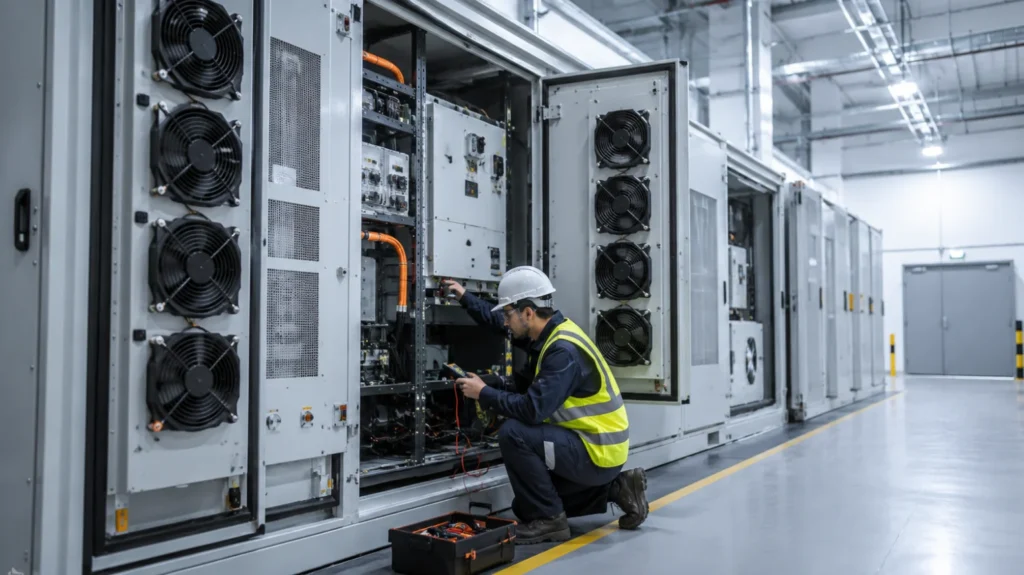
For a 20MWh battery energy storage project, I would not compare liquid cooling and air cooling by looking at thermal performance alone. At this scale, the cooling architecture can influence the number of cabinets required, the amount of land occupied, the complexity of installation, the maintenance model, and the total project investment. Liquid cooling generally offers higher energy density and a more compact layout, while air cooling can reduce initial equipment cost and simplify maintenance. The right choice therefore depends on what the project values most: lower upfront CAPEX, tighter thermal control, smaller footprint, simpler service, or stronger performance under demanding operating conditions.
The table below summarizes the practical differences I would examine first when comparing liquid-cooled and air-cooled BESS configurations for a 20MWh project. These are general project-level differences rather than fixed manufacturer specifications, because actual performance, cabinet capacity, and cost depend on the specific equipment being evaluated.
| Decision Factor | Liquid Cooling BESS | Air Cooling BESS |
| Initial Equipment Cost | Usually higher | Usually lower |
| Energy Density | Higher | Lower |
| Number of Cabinets | Potentially fewer | Potentially more |
| Project Footprint | Smaller | Larger |
| Thermal Uniformity | Better | More dependent on airflow |
| Maintenance | More specialized | Simpler |
| Hot-Climate Suitability | Generally stronger | Requires careful HVAC design |
| High Utilization | Strong fit | Project dependent |
| Land Requirement | Lower | Higher |
| Best Use Case | Space-limited, high-density projects | Cost-sensitive projects with sufficient space |
The first difference most buyers notice is initial equipment cost. Air-cooled systems are often more attractive at this stage because their thermal-management architecture is simpler and avoids some of the pumps, coolant circuits, heat exchangers, and monitoring components associated with liquid cooling. If an EPC is trying to keep the first quotation as competitive as possible, this lower equipment CAPEX can be an important advantage. However, I would never stop the comparison there, because a 20MWh project is large enough for equipment density and physical layout to materially change the rest of the project cost.
Energy density is where liquid cooling can start to create a different project outcome. Because the thermal system relies less on large airflow passages and extensive ventilation space, more battery capacity can often be packaged into the same cabinet footprint. That can reduce the number of units needed to reach the target MWh. In the 20MWh project comparison I encountered earlier, the preliminary options involved approximately four higher-density liquid-cooled units versus around ten air-cooled units. I would not treat this ratio as a standard for every project, but it demonstrates why cabinet quantity matters. Once the number of units changes significantly, the entire installation layout changes with it.
A smaller cabinet count usually means a smaller project footprint, which can be particularly valuable on industrial sites where space is already limited by production buildings, transformers, generators, roads, or future expansion areas. If the customer is working within a constrained site, the higher equipment cost of liquid cooling may be partly justified by lower land demand and a more compact arrangement. On the other hand, if the customer owns a large amount of unused land and space has little economic value, the larger footprint of air cooling may not create a serious disadvantage. In that situation, choosing the lower-cost air-cooled system can still be commercially rational.
Thermal uniformity is another important difference. Liquid cooling removes heat closer to the battery modules and generally allows more controlled temperature distribution across the system. I see this as particularly relevant in high-utilization projects where the battery charges and discharges frequently. Air cooling can still maintain acceptable operating conditions, but performance depends more heavily on airflow design, HVAC capacity, module spacing, and ambient conditions. As the system grows larger, maintaining consistent airflow across every part of the installation becomes increasingly important.
Hot-climate performance deserves the same project-level treatment. In regions with high ambient temperatures, the cooling system has to work harder to maintain the battery within its desired operating range. Liquid cooling can offer advantages because heat is transferred more directly away from the battery modules, while air-cooled systems need carefully designed HVAC and airflow management to maintain stable conditions. I would not conclude that every project in a hot country automatically needs liquid cooling, but I would treat climate as a more important selection factor when the BESS is large, densely packed, and expected to cycle frequently.
Maintenance creates the opposite trade-off. Liquid cooling can deliver tighter thermal control, but it also introduces pumps, coolant circuits, leak detection, and additional inspection requirements. Air cooling is usually easier for local maintenance teams because HVAC systems, fans, and filters are more familiar and can often be serviced with conventional electrical and mechanical skills. In markets where specialized technical support is limited, this simplicity can have real value and should be considered alongside thermal performance.
For a 20MWh project, the most important conclusion I draw from this comparison is that there is no single factor that determines the better solution. Liquid cooling is usually more attractive when the project needs high energy density, compact installation, stronger thermal consistency, and frequent operation. Air cooling remains competitive when the customer prioritizes lower equipment cost, has sufficient land, operates under manageable conditions, and values simpler maintenance. The decision becomes much clearer when the project team compares not only the battery cabinets, but the complete installed system, including land use, civil work, cabling, maintenance access, operating conditions, and long-term performance.
The Cost Question Is More Complicated Than Liquid Cooling Costs More
When I compare liquid-cooled and air-cooled BESS, I do not think the cost discussion should stop at the battery cabinet quotation. That is usually the first number a buyer sees, but it is only one layer of the project economics. Air cooling often looks more attractive at the equipment level because the thermal-management architecture is simpler and the cabinet price can be lower. Liquid cooling may require a higher upfront investment, but higher energy density can reduce the number of units, project footprint, and some of the associated installation work. For a 20MWh project, the more useful question is therefore not simply which cabinet costs less, but which system produces the lower total installed and operating cost under the actual site conditions.
Equipment CAPEX
At the equipment level, air cooling often has a clear advantage. The battery cabinet itself may be priced lower because the thermal-management system is generally built around HVAC equipment, fans, and airflow rather than a dedicated coolant loop with pumps, heat exchangers, liquid channels, and additional monitoring components. When an EPC prepares an early-stage proposal and the end customer is highly sensitive to initial investment, this difference can make the air-cooled option easier to present commercially. A lower cabinet price can reduce the apparent CAPEX and help the project stay within a preliminary budget.
However, I also look at how many units are required to reach the target capacity. A lower price per cabinet does not necessarily mean a lower total battery-system cost if the project needs significantly more cabinets. In a 20MWh project, the number of units can vary substantially depending on the energy density and product architecture being evaluated. This is why I prefer to compare total equipment cost for the complete MWh requirement rather than only comparing the price of one cabinet. The thermal-management system, battery capacity per unit, PCS arrangement, auxiliary systems, and the total number of cabinets all need to be considered together.
Liquid cooling usually requires more expensive thermal-management components, but it can also support higher energy density and reduce the number of physical units needed for the same project capacity. That does not automatically make the liquid-cooled option cheaper, but it changes the structure of the cost comparison. For an EPC, the correct CAPEX discussion should therefore be based on the complete system configuration rather than a simple “air cooling is cheaper” conclusion.
Land and Civil Construction Cost
The cabinet count starts to matter much more when the project moves from equipment pricing into site design. More units require more physical space, and that can affect the civil engineering scope in ways that are easy to overlook during the quotation stage. A larger BESS layout may need additional concrete foundations, wider equipment spacing, more internal access paths, longer perimeter fencing, and more space between equipment depending on the project’s fire and safety design requirements. Drainage, service access, and future maintenance also need to be planned around the larger installation area.
On a site where land is abundant and inexpensive, this may not be a major concern. A factory, mine, farm, or industrial park may already have sufficient unused land, so the additional footprint of an air-cooled system creates little direct economic pressure. In that case, the lower equipment cost can remain a meaningful advantage because the site can absorb the larger layout without affecting production areas or future development.
The situation changes on a constrained industrial site. If the BESS has to fit between existing buildings, transformers, generators, internal roads, or reserved expansion areas, every additional cabinet can reduce design flexibility. A larger footprint may require additional land preparation, relocation of other equipment, or a more complicated site arrangement. In these cases, the higher energy density of a liquid-cooled system can create value because reducing the number of units can simplify the civil layout and preserve usable site area.
This is why I do not treat land cost as a separate issue from the cooling decision. The thermal architecture influences energy density, energy density influences cabinet count, and cabinet count influences civil construction. Once a project reaches tens of megawatt-hours, these relationships become commercially significant.
Electrical Installation Cost
Electrical installation is another area where the equipment count can change the real project cost. A more distributed BESS layout generally creates more power connections, more auxiliary wiring, more communication links, and longer cable routes between battery cabinets, PCS units, transformers, EMS equipment, and the wider electrical system. Each additional unit adds another set of physical interfaces that must be installed, labeled, tested, and commissioned.
I pay particular attention to cable length because a larger footprint can increase the distance between the battery system and the rest of the power-conversion equipment. Longer cable runs can mean more conductor material, more cable trays or trenches, more grounding work, and additional labor. Communication routes also become more complex when more devices need to be connected to the EMS, BMS, monitoring platform, and safety systems.
This is one reason the cheapest cabinet quotation does not always produce the cheapest installed project. A lower-cost air-cooled system may still be the better option, but the EPC should calculate the additional electrical scope created by the larger unit count. Conversely, a more compact liquid-cooled configuration may reduce some installation work, but that saving has to be large enough to justify the higher equipment cost. I find the comparison much more useful when these costs are evaluated together instead of being separated into individual procurement decisions.
Operating and Maintenance Cost
The cost comparison continues after commissioning because both cooling technologies create different operating and maintenance requirements. Air-cooled systems rely on fans, filters, and HVAC equipment, so routine maintenance usually includes filter replacement, fan inspection, HVAC servicing, and ensuring that ventilation paths remain clean and unobstructed. In dusty environments, this can become more important because filters and airflow channels may require more frequent attention. Cooling equipment also consumes auxiliary power, and in hot climates the HVAC system may operate for long periods, which increases the energy used simply to maintain the batteries within their target temperature range.
Liquid-cooled systems have a different maintenance profile. Pumps, coolant loops, heat exchangers, valves, sensors, and leak-detection systems become part of the operating infrastructure. The coolant condition needs to remain within the manufacturer’s specification, and the system may require periodic inspection or servicing of the liquid circuit. These requirements can be more specialized than conventional HVAC maintenance, so local technical capability and access to spare parts become important project considerations.
I therefore avoid describing either technology as inherently cheaper to maintain. Air cooling may be easier for local service teams and can avoid liquid-loop maintenance, but the HVAC and airflow system still requires regular attention. Liquid cooling may provide better thermal control and potentially lower some cooling-related performance losses, but it introduces additional mechanical components that must be monitored over time.
For me, the most useful cost metric is total cost of ownership rather than battery cabinet purchase price. A proper comparison should consider equipment CAPEX, land use, civil construction, electrical installation, auxiliary energy consumption, maintenance requirements, and the way thermal management influences long-term battery performance. Only after those elements are combined can an EPC or project owner understand which cooling architecture is actually more economical for the specific 20MWh project.
Real Project Insight: From a 20MWh Requirement to Two Different BESS Configurations
One of the most useful things I have learned from real BESS project discussions is that a capacity requirement alone does not tell you what the final system should look like. A customer may say they need 20MWh, but that number is only the starting point. Once the project moves into technical evaluation, questions about cabinet density, cooling method, land use, installation complexity, maintenance, and operating conditions quickly become more important. In one Nigeria project discussion, this became very clear because the same approximate 20MWh target led to two very different preliminary configurations. That comparison helped shift the conversation away from simply asking which cabinet was cheaper and toward understanding which system architecture was more practical for the actual site and operating conditions.
Step 1: The Customer Came With a Capacity Requirement
The project began with a larger energy-storage requirement from a customer in Nigeria, with the target capacity reaching approximately 20MWh. At the beginning, the requirement appeared straightforward because the customer had already defined the scale of storage they wanted. However, once we began looking at how that capacity could actually be delivered, it became clear that selecting a battery cabinet was only one small part of the decision.
At that stage, the more useful question was no longer simply, “How much storage does the customer need?” The project had already answered that. The real question became, “What architecture is practical for that storage capacity?” A 20MWh requirement can be achieved through different cabinet sizes, different levels of energy density, different thermal-management designs, and different system layouts. Each route changes the project in a different way, even though the final target capacity may look identical on paper.
This is where I think many early BESS discussions become too product-focused. If an EPC starts by comparing only cabinet specifications or price per kWh, it is easy to miss the wider project consequences. For a system at this scale, the number of units, available site area, electrical layout, operating environment, and maintenance strategy can influence the final decision just as much as the battery capacity itself.
Step 2: Two Preliminary Technical Routes Appeared
During the preliminary comparison, two distinct technical routes emerged. One option used a higher-density liquid-cooled configuration and required approximately four units to reach the target capacity. The second option used an air-cooled configuration and required approximately ten units. The difference was large enough that the cooling discussion immediately became a system-layout discussion rather than a simple comparison of thermal performance.
It is important to be precise about what this comparison means. These quantities came from the specific products and configurations being evaluated in that project and should not be treated as a universal 20MWh design rule. Another supplier, another battery platform, or another cabinet capacity could produce very different numbers. What matters is the principle behind the comparison: higher energy density can reduce the number of physical units required, while a lower-density configuration may need more equipment to reach the same total MWh.
That distinction is important for credibility because I would not want an EPC reader to assume that every 20MWh liquid-cooled solution needs four units or every air-cooled system needs ten. The lesson is not the ratio itself. The lesson is that equipment architecture can significantly change the physical form of the project, and that physical difference can influence cost and implementation.
Step 3: Air Cooling Created an Attractive Cost Argument
At first glance, the air-cooled route had an obvious commercial advantage because the initial equipment investment was lower. For a project owner or EPC trying to control CAPEX, that is a strong argument. A lower equipment quotation can make the proposal easier to approve internally and can reduce the amount of capital required before the system begins operating.
The maintenance structure can also feel more familiar. Air cooling generally relies on HVAC equipment, fans, and ventilation, which are technologies that many local electrical and mechanical teams already understand. That familiarity can reduce the perceived technical risk of the project, especially in markets where highly specialized BESS service capability is still developing. From the customer’s point of view, a simpler thermal-management system can feel easier to maintain over the long term.
This is why I do not think it is useful to assume that a technically more advanced solution will automatically be preferred. The customer’s decision is usually commercial as well as technical. If an air-cooled system can meet the required performance at a lower initial cost and local technicians are more comfortable maintaining it, there is a very rational reason to consider that option seriously.
Step 4: Cabinet Quantity Changed the Project Economics
The cost discussion became more complicated once we compared approximately ten air-cooled units with approximately four liquid-cooled units. At that point, the project could no longer be evaluated only by looking at battery cabinet prices. The larger number of air-cooled units immediately raised questions about how much land would be required, how much foundation work would be needed, how the cabinets would be spaced, and whether the site could provide enough access for installation and future maintenance.
The electrical layout also became more important. A larger number of units can create more cable runs, more power connections, more communication links, and potentially longer distances between the battery equipment, PCS, transformers, and other parts of the system. These differences may increase cable material, trenching, installation labor, and commissioning work. Ten units do not automatically mean dramatically higher installation cost, but they do create more physical interfaces that the EPC has to design and manage.
Land ownership was another practical question. If the customer already has a large amount of available industrial land, a bigger air-cooled layout may have very little economic impact. In that situation, the lower equipment cost can remain a real advantage. If the site is constrained, however, the additional footprint can create problems with existing buildings, roads, generators, transformers, or future expansion areas. The same air-cooled system that looks cheaper in a quotation may therefore become less attractive once the full site layout is considered.
This is one of the most useful lessons I took from the project. Cabinet quantity is not simply a hardware detail. It can affect civil construction, electrical installation, site planning, and future maintenance. Once the number of units changes, the project economics change with it.
Step 5: Climate and Operating Conditions Had to Be Evaluated
Because the project was in Nigeria, site conditions also had to be part of the technical evaluation. High ambient temperatures can increase the workload placed on the thermal-management system, while dust can affect filters, airflow paths, HVAC performance, and maintenance frequency. These conditions do not automatically determine which cooling technology should be used, but they do change how confidently each option can support the expected operating profile.
The daily operating pattern was equally important. A BESS used for occasional backup power creates a very different thermal load from a system that charges and discharges every day for peak shaving, solar energy shifting, or diesel reduction. Frequent cycling means the cooling system has to manage heat repeatedly, so thermal consistency becomes more important as utilization increases.
Maintenance capability also had to be considered. A liquid-cooled system may provide tighter temperature control, but it also requires service capability for pumps, coolant circuits, sensors, and leak monitoring. An air-cooled system may be easier for local teams to maintain, but filters, fans, and HVAC equipment still require regular attention, particularly in hot and dusty environments. For me, this is why climate should be treated as another engineering input rather than a simple rule that “hot country equals liquid cooling.”
Step 6: The Project Could Not Be Decided by Cabinet Price Alone
The broader lesson from this 20MWh project discussion was that the cheapest cabinet configuration is not automatically the cheapest project. A meaningful BESS comparison needs to look at equipment cost together with site cost, installation cost, operating cost, maintenance requirements, and long-term system performance. Once these factors are considered together, the difference between liquid cooling and air cooling becomes much more practical and much less theoretical.
Air cooling may reduce the initial equipment investment, and that can be the right decision when the site has sufficient land, operating conditions are manageable, and maintenance simplicity is valuable. Liquid cooling may require a higher equipment investment, but a more compact layout can reduce site pressure and may offer better thermal consistency for heavily utilized systems. Neither option is automatically superior because the economic value of each advantage depends on the project conditions.
For me, the most important takeaway from this project was the shift in the decision-making process. The project started with a simple 20MWh capacity requirement, but it quickly became a comparison of two complete system architectures. That is how I believe large BESS projects should be evaluated. The final decision should not be based only on the price of the battery cabinet, but on how the complete system will be built, operated, maintained, and supported over its full project life.
When Liquid Cooling Makes More Sense for a 20MWh BESS Project
For a 20MWh BESS project, liquid cooling tends to make the strongest commercial sense when the project is constrained by space, exposed to demanding thermal conditions, expected to cycle frequently, or evaluated on long-term system value rather than minimum upfront CAPEX. I do not see liquid cooling as the default answer simply because the project is large. The better way to judge it is to ask whether its higher energy density, tighter temperature control, and more compact architecture solve problems that would otherwise increase project cost or operating risk. When those conditions are present, the higher initial investment can become easier to justify.
Installation Space Is Limited
Installation space is one of the clearest situations where liquid cooling can create real project value. A factory site, commercial facility, or industrial park rarely has unlimited land available for energy storage. The BESS may need to compete with production buildings, transformers, generators, internal roads, fire access routes, loading areas, utility infrastructure, or planned future expansion. In these environments, the difference between a compact high-density layout and a more spread-out installation can affect the feasibility of the entire project.
Higher energy density can reduce the number of battery cabinets or containers required for the same MWh target, which in turn can reduce the overall footprint of the BESS area. For a 20MWh project, this matters because a reduction in equipment quantity can simplify not only the physical layout but also foundation planning, cable routing, equipment spacing, and maintenance access. I see this as one of the strongest reasons to consider liquid cooling: the value is not only in thermal performance, but in allowing the customer to install more storage capacity within a limited site.
This becomes even more important when the land itself has commercial value. If the BESS occupies space that could otherwise be used for production expansion, warehousing, parking, logistics, or future electrical equipment, the opportunity cost of land starts to matter. In such a case, a more compact liquid-cooled system can create value that is not immediately visible in the battery quotation. The higher equipment price may be offset partly by preserving usable site area and reducing the complexity of fitting the system into an already crowded industrial environment.
The Site Has High Ambient Temperatures
High ambient temperature is another condition where thermal-management capability deserves more attention. When a BESS operates in a hot environment, the cooling system has to work harder to keep the battery within its intended operating range, and the margin for poor thermal control becomes smaller. This is especially relevant for projects in regions where high daytime temperatures are common for much of the year and where the battery system is installed outdoors.
Liquid cooling can be attractive in these conditions because heat is removed closer to the battery modules rather than relying mainly on moving ambient air through the enclosure. That can support tighter temperature control and reduce the dependence on large airflow volumes. For a high-density 20MWh system, this can be particularly valuable because the thermal load is concentrated within a relatively compact footprint.
However, I would not use ambient temperature alone to make the decision. A well-designed air-cooled system can still perform effectively in hot climates if the HVAC capacity, airflow design, cabinet spacing, and operating profile are suitable. The actual selection should still depend on the product specification, the design of the air- or liquid-cooling system, the expected charging and discharging pattern, and the thermal limits defined by the manufacturer. Climate is therefore an important input, but not a shortcut to the final answer.
The Battery Will Cycle Frequently
Liquid cooling becomes more attractive when the battery is expected to work hard every day rather than remain idle for long periods. A BESS used for peak shaving, solar energy shifting, diesel reduction, or frequent grid support may charge and discharge repeatedly, creating recurring thermal loads throughout the operating day. In these applications, thermal management becomes directly connected to the economic value of the system because the battery is expected to perform consistently over many cycles.
Frequent cycling can amplify temperature differences between cells and modules if the cooling system cannot maintain stable conditions. Over time, that can contribute to uneven aging and reduce the consistency of the battery pack. I therefore pay more attention to thermal uniformity when a project has a demanding duty cycle, because the customer is not simply buying installed capacity; they are buying the ability to use that capacity repeatedly.
This is particularly relevant in hybrid projects where the BESS is actively used to reduce diesel generator runtime or shift solar energy into evening demand. In these cases, the storage system may operate every day as part of the site’s normal energy strategy. A cooling architecture that can support repeated charging and discharging with more consistent temperature control may therefore have greater long-term value than one optimized mainly for lower initial cost.
The Customer Values Lifecycle Performance More Than Minimum Initial CAPEX
The final situation where liquid cooling often makes more sense is when the customer evaluates the project over its full operating life instead of focusing only on the lowest purchase price. In many BESS discussions, air cooling appears more attractive at the beginning because the equipment cost is lower and the maintenance concept is simpler. That advantage is real, but it becomes less decisive when the customer also values land use, long-term battery consistency, operating performance, and future expansion flexibility.
A liquid-cooled system may justify a higher initial investment if it allows the project to use fewer cabinets, occupy less land, maintain more stable battery temperatures, and support a demanding operating profile. The economic value of those advantages depends on the project, but in a 20MWh system they can become significant because even small differences are multiplied across a large installed capacity.
I find that the most useful comparison is not “Which cooling technology costs less?” but “Which cooling technology protects the value of the project better over time?” For a customer whose main priority is minimum initial CAPEX, air cooling may still be the right choice. For a customer who places greater weight on compact layout, repeated daily operation, thermal consistency, and long-term system performance, liquid cooling can be the more rational investment.
In that sense, liquid cooling makes the most sense when its advantages solve a real project constraint. If space is limited, ambient temperatures are demanding, battery utilization is high, or lifecycle performance carries more value than the lowest upfront price, the additional investment can be justified by the way it improves the overall project architecture rather than by cooling performance alone.
When Air Cooling Can Still Be the Better Commercial Decision
While liquid cooling offers clear advantages in certain large-scale BESS applications, I do not believe every 20MWh project should automatically move toward a liquid-cooled solution. In real project discussions, the final decision is usually influenced by the customer’s budget strategy, available land, operating requirements, and local service capability. Air cooling can still be the more practical commercial choice when its advantages match the actual project conditions. The goal is not to choose the most advanced technology, but to choose the technology that creates the best overall value for the specific application.
Upfront Budget Is the Main Constraint
For many EPC contractors and project owners, the first priority is controlling initial investment. In these situations, air cooling can provide a meaningful commercial advantage because the thermal-management structure is generally simpler and the equipment cost can be lower compared with liquid-cooled alternatives. When a customer has a strict project budget, a lower initial quotation can make the BESS solution easier to approve and faster to move into implementation.
This is especially relevant in markets where the primary objective is energy availability rather than maximizing system density. For example, if the customer mainly wants backup power protection, diesel reduction, or basic energy management, the immediate financial benefit of reducing upfront CAPEX may be more important than achieving the smallest possible installation footprint.
From my experience, EPC companies often need to balance technical performance with customer affordability. A technically advanced solution has value only when the customer can justify the additional investment. If the project economics do not support the higher initial cost of liquid cooling, an air-cooled system can still provide a reliable and commercially attractive solution.
However, I always recommend looking beyond the first quotation. A lower equipment price is only one part of the project cost. The EPC should still evaluate installation area, electrical work, civil construction, and long-term operation. Air cooling may have a CAPEX advantage, but whether that advantage remains after considering the complete project depends on the actual site conditions.
The Site Has Plenty of Low-Cost Land
Available land is one of the most important factors that can change the cooling decision. If the customer already owns sufficient industrial land, the larger footprint of an air-cooled system may have little economic impact. In this situation, the main disadvantage of lower energy density becomes less important because the project does not face strong space limitations.
For example, a large factory, agricultural facility, mining operation, or utility-scale project may have enough available land to install additional battery cabinets without affecting other operations. The customer may not need to purchase additional land, redesign existing facilities, or sacrifice valuable production space. Under these circumstances, paying more for a compact liquid-cooled system may not create enough additional value to justify the higher equipment cost.
This is an area where I think project discussions need to be more realistic. A smaller footprint is valuable, but only when the footprint creates a real economic benefit. If the customer has abundant and inexpensive land, the advantage of saving installation space becomes less significant. The project may achieve better overall economics by accepting a larger layout and using the CAPEX savings from an air-cooled solution for other parts of the system.
The key question is not whether a smaller BESS footprint is technically better. The question is whether the customer actually needs that smaller footprint. If space is not a limitation, air cooling can remain a very reasonable commercial decision.
The Operating Profile Is Less Demanding
The expected operating pattern of the BESS also has a major influence on the cooling selection. Not every energy-storage project requires intensive daily cycling. Some systems are designed mainly for emergency backup, occasional peak support, or limited-duration power protection. In these applications, the thermal-management requirements may be less demanding compared with a BESS that charges and discharges multiple times every day.
For an emergency backup application, the battery may spend most of its operating life waiting for a grid outage or specific power event. The system still needs to be reliable, but the thermal workload can be very different from a project used for continuous energy arbitrage, solar shifting, or aggressive diesel reduction.
In these cases, air cooling may provide a practical balance between performance and investment. The customer may not receive the same level of thermal density or compactness as a liquid-cooled system, but those advantages may not generate enough additional value if the battery is not being heavily utilized.
I usually look at the relationship between system usage and technology investment. If a customer is using the BESS as an active energy asset every day, thermal performance becomes more commercially important. If the system is mainly providing backup capacity with limited cycling, the lower complexity and lower upfront cost of air cooling can become a stronger advantage.
Local Maintenance Capability Favors Simpler Systems
Maintenance capability is another factor that is sometimes underestimated during technology selection. A BESS is not only installed equipment; it is a long-term operating asset. The customer needs confidence that local technicians can maintain the system, diagnose problems, and obtain support throughout the project lifecycle.
In some markets, local service teams have extensive experience with conventional HVAC systems, fans, filters, and ventilation equipment. These technologies are familiar, and spare parts or technical support may be easier to access. For customers operating in regions where specialized liquid-loop service capability is limited, the simplicity of an air-cooled architecture can reduce perceived maintenance risk.
Liquid cooling can provide excellent thermal management, but it introduces additional components such as pumps, coolant circuits, sensors, and leak-monitoring systems. These systems require specific knowledge and proper maintenance procedures. If local technical resources are not prepared, the theoretical advantages of liquid cooling may become less valuable in practice.
This does not mean air cooling is always easier or better. Air-cooled systems still require regular HVAC maintenance, filter management, and airflow inspection, especially in hot or dusty environments. The important point is that technology selection should consider the real maintenance environment, not only laboratory performance.
For me, the best BESS solution is the one that the customer can operate successfully for many years after installation. A system that matches local skills, available service resources, and the customer’s operational expectations can often create more value than selecting a more advanced technology that is difficult to support.
Ultimately, air cooling remains a strong commercial option when the project prioritizes lower upfront investment, has sufficient land availability, operates under moderate cycling conditions, and requires a simpler maintenance approach. The right decision is not about choosing the most advanced cooling technology; it is about matching the cooling architecture with the customer’s real business requirements.
Cooling Technology Is Only One Part of BESS System Design
When discussing liquid cooling versus air cooling, it is easy to focus too much on the cooling system itself. However, from my experience, cooling technology is only one part of a much larger BESS architecture. A battery energy storage system is not simply a collection of battery cabinets with a cooling solution attached. It is a complete energy system where battery performance, power conversion, energy management, renewable generation, and backup power sources must operate together.
For a 20MWh project, choosing the right cooling method is important, but it cannot be separated from the overall system design. A technically excellent cooling solution cannot compensate for poor system integration, incorrect power sizing, weak EMS logic, or an unsuitable operating strategy. The final project success depends on how all components work together throughout the entire operating lifecycle.
Battery, PCS, BMS and EMS Must Work as One System
A successful large-scale BESS project requires coordination between multiple systems, including the battery system, PCS, BMS, EMS, thermal management, grid connection, solar PV system, and diesel generator where applicable. Each component has a different role, but the overall performance depends on how effectively they communicate and operate as one integrated platform.
The battery system provides the energy storage capacity, but the battery alone cannot deliver a complete solution. The PCS controls the conversion between DC power from the battery and AC power required by the facility or grid. The BMS protects and monitors individual cells and modules, managing important parameters such as voltage, current, temperature, and battery health. The EMS coordinates the overall energy strategy, deciding when to charge, when to discharge, how to prioritize renewable energy, and how to interact with the grid or generator.
In hybrid applications, this integration becomes even more important. For example, a solar + battery + diesel hybrid system is not simply a combination of three separate technologies. The EMS needs to manage when solar power should supply the load, when excess solar should charge the battery, when the battery should discharge, and when the diesel generator should start or reduce output. The objective is usually not only maintaining power availability but also reducing fuel consumption, improving energy efficiency, and optimizing operating costs.
This integrated approach is also how I view the role of Mars Solar in BESS projects. Based on Mars Solar’s product positioning, the company focuses not only on individual battery products but on integrated power generation and storage solutions, including lithium battery systems, bidirectional inverter solutions, BMS/EMS functions, and smart switching between grid, solar, and generator sources. In real commercial and industrial projects, customers are usually not looking for a battery cabinet alone. They need a complete system that can be configured, installed, commissioned, and operated reliably.
For a 20MWh project, the relationship between thermal management and the rest of the system is also important. The cooling system affects battery operating conditions, but battery operating strategy affects cooling demand. A frequently cycled battery system, for example, creates different thermal requirements compared with a standby backup system. The EMS operating strategy, PCS power rating, battery capacity, and cooling design all influence each other.
This is why I believe a BESS should always be evaluated as an integrated energy solution rather than as separate equipment categories. The battery, PCS, BMS, EMS, and thermal-management system must be designed together to achieve the expected project performance.
Cooling Selection Should Follow the Project Architecture
One of the biggest mistakes I see in BESS discussions is selecting the cooling technology too early. Some buyers begin with the assumption that liquid cooling is always the future direction, while others focus only on achieving the lowest initial equipment cost through air cooling. Both approaches can create problems because they start with the technology choice before understanding the actual project requirements.
The better approach is to define the project operating requirements first and then determine the appropriate BESS architecture and cooling technology. The project should begin with questions such as: How much energy capacity is required? How frequently will the battery cycle? What is the customer’s load profile? How much installation space is available? What are the local climate conditions? What maintenance capability exists in the target market?
Only after these questions are answered can the EPC and supplier determine whether liquid cooling or air cooling provides better overall value.
For example, a 20MWh BESS installed in a space-limited industrial facility with daily cycling, high ambient temperatures, and strong demand for long-term performance may benefit from a higher-density liquid-cooled architecture. The compact design and thermal consistency may create meaningful project value.
However, a similar 20MWh project installed on a large site with inexpensive land, moderate operating requirements, and strong local HVAC maintenance capability may achieve better economics with an air-cooled system. The lower initial investment and simpler service requirements may better match the customer’s priorities.
This is the reason I do not consider liquid cooling or air cooling to be a simple question of which technology is better. The right choice depends on how the entire BESS system is designed around the customer’s business objective.
A successful BESS project is not created by selecting the most advanced component. It is created by selecting the right combination of battery technology, power electronics, energy management, thermal design, and system integration. Cooling technology is an important decision, but it should always follow the project architecture rather than forcing the project to fit a specific cooling solution.
How Mars Solar Approaches BESS Project Evaluation With EPC Partners
When I work with EPC partners on BESS projects, I believe the most important step is not selecting a battery cabinet first. A successful energy-storage project starts with understanding the customer’s actual energy challenge and then building the right technical solution around that requirement.
In many project discussions, customers initially provide a simple request such as “we need a 20MWh battery system” or “we need a solar + storage solution.” However, behind that request are many important questions: What is the customer’s load profile? What problem is the BESS expected to solve? Is the goal backup power, diesel reduction, solar energy shifting, peak shaving, or grid support? How much installation space is available? What are the local operating conditions?
At Mars Solar, I believe our role is not simply to provide a battery product quotation. Our role is to work with EPC partners to evaluate the complete project requirements, compare suitable technical routes, and help develop a practical BESS solution that can be successfully delivered and operated.
Start With Project Requirements Rather Than a Standard Product
The first step in our project evaluation process is understanding the customer’s real requirements before discussing specific equipment. Every BESS project has different operating objectives, and the system design needs to reflect those differences.
I usually begin by understanding the customer’s load requirements and energy objectives. This includes reviewing the power demand, required backup duration, expected energy consumption pattern, and the role the BESS will play within the overall energy system. For example, a commercial facility seeking backup power will have different requirements from an industrial customer looking to reduce diesel consumption or shift solar energy into evening peak hours.
After understanding the application scenario, the next step is determining the appropriate system capacity and architecture. The required MW power rating, MWh storage capacity, battery configuration, PCS selection, and control strategy all need to work together. A storage system should not be oversized without purpose, but it should also provide sufficient capacity and performance to meet the customer’s operational expectations.
Site conditions are another important part of our evaluation process. The available installation area, climate conditions, grid environment, existing generators, solar PV systems, and future expansion plans can all influence the final design. For example, a customer with limited installation space may prioritize a higher-density solution, while a customer with sufficient land may focus more on initial investment and maintenance simplicity.
This approach is consistent with the project process we follow at Mars Solar, which moves from customer inquiry and demand analysis into system design, production, testing and delivery, installation guidance, and project acceptance. Each stage helps reduce uncertainty before the customer commits to a final solution.
For EPC partners, this process creates more confidence because the final proposal is based on the actual project conditions rather than a standard product recommendation. A BESS project is not successful because a battery cabinet was selected correctly; it is successful because the entire system matches the customer’s operational needs.
Compare More Than the Battery Cabinet Price
One of the most common mistakes in BESS evaluation is focusing only on the battery cabinet price. While equipment cost is important, it does not represent the complete project economics. A lower-priced cabinet may require more units, more installation space, more electrical connections, or additional construction work. A higher-density solution may have a higher initial price but create value through a more compact design and simplified installation.
When working with EPC partners, I believe the comparison should include the complete system configuration rather than a single equipment quotation. This means evaluating the number of battery units required, overall footprint, PCS and integration approach, communication requirements, installation complexity, and expected operating conditions.
For example, when comparing two possible solutions for a 20MWh project, the question should not only be “Which battery cabinet costs less?” The more useful questions are: How many units are needed? How much land is required? How complex is the electrical connection? What maintenance resources are available locally? How will the system perform over the project lifecycle?
This broader evaluation helps EPC partners provide more valuable proposals to their customers. Instead of competing only on equipment price, they can explain the complete technical and commercial logic behind the recommended solution.
At Mars Solar, our focus is supporting EPC partners with practical system solutions rather than positioning ourselves as a large utility-scale EPC contractor. We understand that many local EPC companies already have project experience, installation teams, and customer relationships, but they may need a reliable technology partner who can support system configuration, product integration, technical communication, and delivery coordination.
Our goal is to make the project development process easier by combining product capability with engineering support. Whether the final solution uses air-cooled or liquid-cooled BESS, the decision should be based on the customer’s requirements, site conditions, and long-term project value.
I believe this is the foundation of a successful BESS partnership. The strongest projects are not created by selling the most expensive system or the cheapest system. They are created when the EPC partner and technology supplier understand the project together and select the solution that best fits the customer’s real energy needs.
Frequently Asked Questions About Liquid Cooling vs Air Cooling BESS
When EPC contractors and energy solution providers evaluate a large-scale BESS project, the question of liquid cooling versus air cooling often appears during the system design stage. However, from the projects I have been involved in, I have noticed that customers are rarely searching for cooling technology itself. The real concern is usually how different thermal-management approaches will influence the overall project design, investment, installation requirements, and long-term operation.
A 20MWh energy-storage requirement, for example, is not simply a question of selecting a battery cabinet. The final solution needs to consider capacity, power requirements, available installation space, climate conditions, operating cycles, maintenance capability, and lifecycle economics. Cooling technology is an important part of this decision, but it should always be evaluated as part of the complete BESS architecture.
Is liquid cooling always better for a 20MWh BESS?
No. A 20MWh project does not automatically mean that liquid cooling is the better choice. Although liquid-cooled BESS solutions have clear advantages in thermal consistency, energy density, and space utilization, the most suitable cooling technology depends on the actual project environment and operating requirements.
In my experience, many EPC companies initially approach this question from a technology perspective, asking whether liquid cooling is more advanced than air cooling. However, the more important question is whether the additional performance and higher energy density create enough commercial value for that specific project. A battery-storage system installed in a limited-space industrial facility with frequent daily cycling may benefit significantly from liquid cooling, because reducing cabinet quantity and improving thermal control can directly influence project economics.
On the other hand, a project with sufficient land availability, moderate operating requirements, and a strong focus on initial investment may still achieve a practical and reliable solution with air cooling. The decision should not be based only on the cooling method itself, but on how the complete system performs under real operating conditions.
Is an air-cooled BESS cheaper than a liquid-cooled BESS?
At the equipment level, an air-cooled BESS is often more attractive from an initial investment perspective. The thermal-management structure is generally simpler because it mainly relies on HVAC systems, fans, and airflow management rather than additional liquid circulation components such as pumps, coolant loops, and related monitoring systems.
For many EPC contractors, especially when preparing competitive project quotations, this lower upfront equipment cost can be an important advantage. A solution with a lower initial price may help customers meet budget limitations or improve the competitiveness of a project proposal.
However, the equipment purchase price is only one part of the total BESS project cost. One of the most important considerations that is sometimes overlooked is the relationship between cooling technology and system footprint. Because air-cooled systems may have lower energy density depending on the product architecture, achieving the same 20MWh capacity may require a larger number of battery cabinets.
More cabinets can create additional costs related to installation space, foundations, cable routing, electrical connections, equipment spacing, and construction labor. Therefore, while air cooling can provide a lower cabinet price, it does not always guarantee the lowest total project cost. A complete evaluation should consider the entire project lifecycle rather than only the initial equipment quotation.
Why does liquid cooling require less installation space?
Liquid-cooled BESS systems can achieve higher installation density because the thermal-management method allows heat to be removed closer to the battery modules. Instead of depending mainly on airflow movement through the enclosure, liquid cooling uses cooling plates, liquid channels, pumps, and heat exchangers to maintain a more controlled temperature environment around the battery cells.
This difference becomes increasingly important as battery capacity grows. In a multi-megawatt-hour project, the number of battery cells and modules increases significantly, and maintaining consistent temperature across the entire system becomes more challenging. By improving heat-transfer efficiency, liquid cooling can allow manufacturers to package more battery capacity into each cabinet.
For EPC partners, the practical impact is not only technical performance but also project layout. A 20MWh system using higher-density liquid-cooled cabinets may require fewer units compared with a lower-density air-cooled configuration. This can reduce land requirements, simplify site planning, and become especially valuable in applications where available space is limited, such as factories, commercial facilities, and industrial parks.
However, the space advantage of liquid cooling only creates real value when the project actually has land constraints. If a customer already owns large amounts of low-cost industrial land, the economic benefit of a smaller footprint may not be significant enough to justify the additional investment.
Can air cooling be used for a 20MWh project?
Yes. A 20MWh BESS project can still be designed with air cooling depending on the product architecture and operating conditions. Project capacity alone should not determine the cooling method because different applications have different performance requirements.
For example, an energy-storage system designed mainly for emergency backup may have very different requirements compared with a system used for daily peak shaving, solar energy shifting, or diesel fuel reduction. A backup application with limited cycling frequency may place greater importance on initial investment and maintenance simplicity, while a frequently cycled system may require stronger thermal-management performance.
Air cooling can also be a practical choice in regions where local technicians are more familiar with conventional HVAC-based maintenance. In some markets, easier service accessibility and lower technical complexity can provide meaningful operational advantages.
The key consideration is not whether air cooling can support a 20MWh project, but whether it matches the customer’s operating objectives, site conditions, and long-term expectations.
What matters more than cooling technology when selecting a BESS?
Cooling technology is only one element of a successful energy-storage system. A reliable BESS project requires coordination between battery modules, PCS, BMS, EMS, thermal management, solar generation, grid connection, and backup power sources such as diesel generators when required.
From my perspective, the strongest BESS proposals begin with understanding the customer’s actual energy problem rather than selecting a product first. The project evaluation should start with questions such as: How much energy storage is required? What is the expected discharge duration? How frequently will the system cycle? What climate conditions will it operate in? How much installation space is available? What level of maintenance capability exists locally?
These factors determine whether a higher-density liquid-cooled solution or a simpler air-cooled solution creates better value. A technically advanced system is not always the best commercial solution, and the lowest initial equipment price does not always represent the lowest overall project cost.
At Mars Solar, we approach BESS projects by evaluating the complete system architecture, including energy storage requirements, inverter integration, EMS control strategy, installation environment, and project economics. The goal is not simply to select liquid cooling or air cooling, but to develop a system configuration that can reliably support the customer’s real operating needs throughout the project lifecycle.