| No. | Supplier | Country | Key Advantages | Best Fit Customer Type |
| 1 | Mars Solar | China | Complete Solar + Battery + Diesel Hybrid System integration, flexible project support, customized BOM, technical assistance, and solutions designed for emerging markets | Solar EPC Contractors, Electrical Contractors, Commercial Project Developers, Agricultural Energy Projects |
| 2 | Schneider Electric | France | Strong industrial energy management, automation, electrical infrastructure, and advanced energy control solutions for complex commercial and industrial systems | Large EPC Contractors, Industrial Facilities, C&I Energy Solution Companies, Infrastructure Projects |
| 3 | SMA Solar Technology | Germany | Premium inverter technology, reliable solar energy management, strong installer ecosystem, and professional monitoring capabilities | Professional Solar Installers, EPC Contractors, Commercial Solar Projects |
| 4 | Huawei Digital Power | China | Intelligent solar and storage ecosystem, advanced digital energy management, scalable commercial and industrial solutions | Large EPC Companies, Industrial Users, Commercial Energy Projects, Energy Solution Providers |
| 5 | Sungrow Power Supply | China | Strong inverter technology, battery storage solutions, large-scale renewable energy experience, and broad global project capability | EPC Contractors, Renewable Energy Developers, Commercial & Industrial Projects |
| 6 | Tesla Energy | United States | Advanced battery technology, software-based energy management, strong brand recognition, and premium storage solutions | Premium Commercial Users, Technology-Focused Businesses, Energy Independence Projects |
| 7 | CATL Energy Storage | China | Leading lithium battery technology, large-scale manufacturing capability, long lifecycle energy storage solutions | Large EPC Contractors, Industrial Energy Projects, Utility & Commercial Storage Developers |
| 8 | BYD Energy Storage | China | Strong battery manufacturing capability, vertical integration, reliable energy storage technology, and broad application experience | Commercial Projects, Energy Solution Companies, Large Storage Applications |
| 9 | Deye Energy | China | Flexible hybrid inverter solutions, cost-effective solar-plus-storage systems, and practical applications for emerging markets | Small & Medium EPC Contractors, Solar Installers, Commercial Backup Power Projects |
| 10 | AlphaESS | Germany | Specialized battery energy storage solutions, intelligent energy management, and integrated storage applications | Commercial Users, Energy Solution Providers, Distributed Energy Projects |
As demand for reliable electricity continues to grow in emerging markets, Solar + Battery + Diesel Hybrid Systems are becoming an increasingly important solution for businesses that need stable power, lower fuel costs, and better energy independence. However, choosing the right supplier is not simply about finding a company that sells solar panels, batteries, or inverters. A successful hybrid project requires the right combination of equipment, system design, technical support, and project experience.
From my experience working with international solar projects at Mars Solar, I have found that many hybrid projects face similar challenges. Customers may have reliable local installation teams or project opportunities, but they often need a supplier who can help coordinate solar generation, battery storage, and diesel backup into one complete solution. Equipment compatibility, technical communication, and after-sales support can directly influence whether a project operates successfully.
This is why evaluating Solar + Battery + Diesel Hybrid System suppliers requires looking beyond product price. A supplier with strong system integration capability, experience in commercial and industrial applications, and the ability to support local EPC partners can often create more value than a supplier offering only the lowest quotation.
What Does a Solar + Battery + Diesel Hybrid System Actually Solve?
When companies search for Solar + Battery + Diesel Hybrid System suppliers, they are usually not simply looking for solar equipment. Behind this search is often a much larger business challenge: how to maintain reliable electricity, reduce operating expenses, and protect daily operations from unstable power conditions. Through working with international solar projects, one thing has become increasingly clear — the demand for hybrid power systems is driven less by the technology itself and more by the operational problems businesses face every day.
In many emerging markets, especially regions with unstable grids or high diesel dependency, businesses have traditionally relied on diesel generators as their primary backup power source. While generators provide immediate reliability, long-term operation creates significant pressure through fuel costs, maintenance requirements, and uncertainty caused by fluctuating diesel prices. A Solar + Battery + Diesel Hybrid System provides a more balanced approach by combining renewable energy generation, energy storage, and backup generation into one coordinated power solution.
The purpose of a hybrid system is not simply to replace diesel generators completely. In many commercial and industrial applications, diesel remains an important backup resource. Instead, the focus is on creating a smarter energy structure where solar and batteries can handle more of the daily energy demand, while the generator operates only when additional support is required.
Reducing Diesel Dependency and Improving Long-Term Energy Economics
Diesel dependency remains one of the biggest challenges for businesses operating in areas where electricity supply is unreliable or expensive. Factories, hotels, farms, mining sites, and commercial facilities often cannot stop operations when the grid fails, which means diesel generators become a necessary but expensive solution.
The challenge is that generators are designed primarily as backup power equipment, but in many regions they are used as the main electricity source for several hours every day. This creates a cycle of continuous fuel consumption, frequent maintenance, and increasing operating costs. For businesses with large energy demand, diesel expenses can become one of the biggest barriers to profitability.
A properly designed Solar + Battery + Diesel Hybrid System helps change this operating model. During periods of strong solar production, solar energy can directly support business loads while excess energy is stored in batteries. When solar availability decreases, stored energy can continue supporting the system before the diesel generator needs to operate. This intelligent coordination reduces unnecessary generator running time and allows businesses to use fuel more efficiently.
From a project perspective, the value of hybrid technology is not only measured by the amount of solar energy generated. The more important measurement is how effectively the system reduces dependence on expensive diesel consumption while maintaining reliable power availability. For many businesses, this creates a practical path toward lower energy costs without sacrificing operational stability.
Protecting Business Operations From Unstable Electricity Supply
For commercial and industrial users, electricity reliability is often directly connected to business performance. A power interruption is rarely just a temporary inconvenience. It can result in production delays, damaged equipment, reduced customer satisfaction, and financial losses.
This challenge is particularly significant for industries such as manufacturing facilities, hotels, agricultural operations, healthcare facilities, and remote industrial sites. A factory interruption may stop production lines and delay customer orders. A hotel outage can affect guest experience and reputation. A farm without reliable electricity may struggle with irrigation and processing activities. In healthcare environments, unstable power can create even more serious operational risks.
Because of this, many businesses are no longer evaluating energy solutions only based on electricity cost reduction. They are looking for energy security — a system that can continue supporting critical operations even when the traditional power supply becomes unreliable.
Solar + Battery + Diesel Hybrid Systems provide this additional layer of protection by combining multiple energy sources. Solar reduces dependence on external electricity, batteries provide fast-response backup power, and diesel generators provide extended support when longer operating periods are required. This creates a more resilient energy system compared with relying on a single power source.
The key consideration in these projects is not simply how much electricity the system produces, but whether the system can support the business when power conditions change. This is why hybrid systems are becoming increasingly important for companies that cannot afford operational interruptions.
Solving the Challenges Created by Fragmented Equipment Supply
One of the most common issues in international solar projects is that customers purchase different components separately without considering the complete system integration process. On paper, buying an inverter from one supplier, a battery from another supplier, and a control system from a third supplier may appear to provide flexibility or lower initial costs. However, the challenges often appear later during installation, commissioning, and long-term operation.
A hybrid power system is not simply a collection of independent products. It is an integrated energy system where each component needs to communicate and operate correctly together. The inverter must properly coordinate with the battery management system. The energy management system needs to control the interaction between solar generation, battery charging, grid conditions, and diesel generator operation. The overall system design must also consider load characteristics, future expansion, and local operating conditions.
Without proper integration, even high-quality individual components may create project risks. These risks can include incorrect system sizing, communication problems, inefficient energy management, and unclear responsibility when technical issues occur. This is one of the reasons experienced EPC contractors often prefer working with suppliers who understand complete system delivery rather than suppliers who only provide individual products.
A reliable Solar + Battery + Diesel Hybrid System supplier should support more than equipment supply. The supplier should be able to assist with system configuration, technical documentation, equipment matching, production testing, and project communication. This approach reduces uncertainty for EPC companies and helps ensure that the final installed system performs according to project expectations.
For Mars Solar, this understanding is central to how we approach hybrid energy projects. The role of a reliable Chinese supplier is not only to provide solar equipment and batteries but also to help international partners successfully deliver complete power solutions. In real-world projects, the success of a hybrid system depends on how well all parts work together — because the final goal is not selling components, but helping businesses achieve reliable, cost-effective, and sustainable power.
What Is Really Happening Behind the Search? A Real Hybrid Solar Project Scenario
When I analyze why EPC contractors search for terms such as “Solar + Battery + Diesel Hybrid System Suppliers,” I do not see this as a simple product search. In most cases, the search happens because an EPC company already has a real project opportunity but needs a reliable technology and supply partner to help transform a customer requirement into an operating energy system.
From my experience observing international solar projects, the biggest challenge is rarely finding individual solar panels, batteries, or inverters. These products are widely available in the market. The more difficult challenge is finding a supplier who understands how these components need to work together under real operating conditions, especially in regions where grid reliability, diesel dependency, and local installation challenges create additional complexity.
A hybrid solar project is ultimately a cooperation between multiple parties. The local EPC contractor understands the customer, site conditions, installation environment, and local regulations. The system supplier provides equipment integration, technical support, and supply chain coordination. When these two capabilities work together, the project has a much higher chance of successful delivery.
To better understand this, I would like to share a typical project scenario that represents many situations faced by EPC contractors in emerging energy markets.
A Commercial Factory Project in Nigeria: Moving From Diesel Dependency to Hybrid Power
Imagine a local EPC contractor in Nigeria receiving a project request from a manufacturing company. The factory owner is facing increasing operational pressure because the existing power structure depends heavily on grid electricity combined with diesel generator backup.
The factory cannot afford frequent shutdowns because production interruptions directly affect delivery schedules, customer relationships, and revenue. At the same time, diesel consumption continues increasing because the generator needs to operate more frequently whenever grid power becomes unavailable.
The customer’s main requirements are straightforward: reduce diesel consumption, maintain production during grid outages, and create a more reliable long-term power solution.
The existing energy system includes grid electricity as the primary source and diesel generators as backup support. However, after months or years of operation, several problems begin to appear. Fuel expenses continue increasing, fluctuations in diesel prices make operating costs difficult to predict, generator maintenance becomes more frequent, and unexpected power interruptions create additional business risks.
For the EPC contractor, this is not simply an equipment replacement project. The customer does not just need a cheaper generator or more solar panels. They need a complete energy strategy that can reduce operating costs while maintaining the reliability required for industrial production.
This is where a Solar + Battery + Diesel Hybrid System becomes a practical solution. The EPC contractor begins evaluating a system that combines solar PV generation, battery energy storage, and integration with the existing diesel generator.
The objective is not necessarily to remove diesel completely. Instead, the system is designed to allow solar energy and battery storage to handle more of the daily energy demand while keeping the diesel generator available as a reliable backup source when additional power is required.
Why Finding the Right Supplier Becomes the Biggest Challenge
During the supplier selection process, the EPC contractor quickly realizes that purchasing equipment is not the same as delivering a complete hybrid power project.
The first challenge appears when working with traditional solar equipment suppliers. A supplier may be able to provide high-quality solar modules, but that does not always mean they understand the complete hybrid system design. Solar panels are only one part of the project, and the success of the system depends on how all energy sources operate together.
The EPC contractor needs support with system sizing, battery capacity selection, inverter matching, and overall energy management. A supplier who only provides individual components may not be able to support these critical decisions.
The second challenge appears when evaluating battery suppliers. Battery storage is a core part of a hybrid system, but a battery alone cannot guarantee project success. The EPC contractor needs to understand whether the battery system can communicate correctly with the inverter, whether the Battery Management System can operate effectively, and whether the energy management system can coordinate solar generation, battery charging, and diesel generator operation.
A battery supplier may provide excellent battery products but still lack experience in complete hybrid integration.
The third challenge comes from suppliers offering the lowest quotation. At first, a lower price may appear attractive, especially when comparing different proposals. However, during technical discussions, the EPC contractor discovers that some suppliers cannot provide essential project support, such as technical drawings, installation guidance, commissioning assistance, or reliable after-sales communication.
For a commercial factory project, these missing elements can create significant risks. A lower equipment price does not necessarily mean a lower project cost if installation problems, delays, or system failures occur later.
What EPC Contractors Actually Need From a Hybrid System Partner
Through these project situations, I believe the role of a hybrid system supplier has changed. EPC contractors are no longer only looking for companies that can provide equipment at competitive prices. They are looking for partners who can reduce project uncertainty.
A suitable hybrid system supplier should be able to support the complete project process, starting from system configuration and equipment selection. The supplier should understand the customer’s energy requirements and help develop a practical system design that matches the actual application.
For EPC contractors, having a complete Bill of Materials is also extremely important. A well-prepared BOM helps them prepare accurate quotations, control project costs, and avoid unexpected missing components during installation.
Technical documentation is another important factor. Commercial and industrial projects require clear information for engineering review, installation planning, and future maintenance. Suppliers who can provide professional technical documents make it easier for EPC contractors to deliver projects confidently.
Beyond documentation, equipment coordination and production testing also play an important role. A hybrid system contains multiple interconnected components, so ensuring that the equipment is properly prepared before shipment can significantly reduce problems during installation.
Finally, remote technical support becomes especially valuable for international projects. Since many EPC contractors operate thousands of kilometers away from their suppliers, having access to technical assistance during installation and commissioning can make a significant difference.
The Real Buying Decision Behind Hybrid Solar Projects
When companies search for Solar + Battery + Diesel Hybrid System suppliers, the real question is rarely:
“Who sells the cheapest battery or inverter?”
The deeper question is:
“Who can help us successfully deliver the entire hybrid power project?”
This is the difference between buying products and building a reliable energy solution.
A successful hybrid project requires more than individual equipment. It requires system understanding, technical cooperation, supply chain coordination, and long-term support between the EPC contractor and the supplier.
For this reason, the most valuable hybrid system partners are not necessarily the companies offering the lowest initial price. They are the companies that can help local project teams confidently move from customer requirements to a fully operating power system.
This is why Mars Solar focuses on supporting EPC contractors and energy solution providers with complete solar, battery storage, and hybrid system solutions. The goal is not simply to supply equipment from China, but to become a reliable technical and supply partner that helps international partners successfully deliver real-world energy projects.
How We Selected the Top Solar + Battery + Diesel Hybrid System Suppliers in 2026
When evaluating Solar + Battery + Diesel Hybrid System suppliers, the most important consideration is not simply company size, product quantity, or the lowest quotation. A hybrid power project involves multiple technologies working together, and the supplier’s ability to support the complete project process often determines whether the final system can operate reliably.
In my experience working with international solar projects, many buyers initially focus on equipment specifications and pricing, but the real challenges usually appear later during system integration, installation, commissioning, and long-term operation. A supplier that can provide individual components is not always capable of delivering a successful hybrid energy project. For this reason, this ranking focuses on practical evaluation factors that matter to EPC contractors, energy solution providers, distributors, and commercial project owners.
The purpose of this evaluation is not to identify one supplier that is suitable for every application. Different projects have different requirements. A factory requiring continuous production power, a remote agricultural project, and a commercial building backup system may all need different technical approaches. Instead, the suppliers are evaluated based on their ability to provide reliable hybrid solutions, technical cooperation, and long-term project support.
Hybrid System Integration Capability
The first and most important factor is whether a supplier has genuine hybrid system integration capability rather than simply selling separate solar products. A Solar + Battery + Diesel Hybrid System requires multiple energy sources to work together through proper system design and intelligent control. Solar generation, battery storage, diesel generators, and energy management systems must communicate effectively to ensure stable operation under different conditions.
Many suppliers can provide solar panels, inverters, or batteries individually, but hybrid projects require a deeper understanding of how these components interact. The supplier needs to understand energy flow management, battery charging and discharging strategies, generator coordination, and system protection requirements. Without this integration capability, even high-quality equipment may not deliver the expected performance.
From a project perspective, the value of a hybrid supplier is not only measured by the products they manufacture but also by their ability to create a complete energy solution. This is why system integration capability becomes one of the most important criteria when evaluating suppliers for commercial and industrial hybrid projects.
Commercial and Industrial Project Experience
A supplier’s experience with real commercial and industrial applications is another important evaluation factor because hybrid systems operate very differently depending on the project environment. A system designed for a factory with heavy machinery has completely different requirements from a hotel, farm, mining site, or remote community power project.
Real project experience shows whether a supplier understands practical challenges beyond technical specifications. Commercial customers often require stable power for critical operations, while remote projects may require higher reliability because technical support and maintenance resources are limited. Environmental conditions, load patterns, and customer expectations can significantly influence system design.
When reviewing hybrid system suppliers, I pay close attention to whether they have experience supporting applications such as factories, hotels, agricultural operations, mining sites, and off-grid facilities. A supplier with diverse application experience is usually better prepared to provide realistic recommendations because they understand how energy systems perform in different operating environments.
Technical Support Capability
Technical support is one of the biggest differences between an equipment supplier and a reliable project partner. A hybrid power system requires technical cooperation throughout the project lifecycle, starting from the initial design stage and continuing through installation, commissioning, and operation.
A professional supplier should be able to support customers with system configuration, load analysis, battery sizing, Bill of Materials preparation, installation guidance, and troubleshooting assistance. These capabilities are especially important for international EPC contractors because they often need to coordinate projects remotely and rely on supplier expertise during critical stages.
In many overseas projects, the equipment itself is not the biggest challenge. The challenge is ensuring that the system is correctly designed for local conditions and installed according to technical requirements. Suppliers that provide strong technical communication and documentation help reduce project risks and give customers greater confidence during implementation.
Product Portfolio and System Compatibility
A complete hybrid energy solution requires more than one product category. Suppliers need the ability to support key components, including solar inverters, LiFePO4 battery systems, power conversion systems, monitoring platforms, and complete packaged solutions.
However, having many products does not automatically mean a supplier can deliver a reliable system. The more important question is whether these products are designed to operate together as an integrated solution. Compatibility between inverter systems, battery management systems, monitoring platforms, and energy control logic directly affects system stability and long-term performance.
From my perspective, suppliers with stronger product integration capabilities can provide greater value because customers do not need to coordinate multiple unrelated manufacturers. This reduces communication complexity, improves project efficiency, and creates clearer responsibility when technical issues occur.
Global Export Experience and Regional Application Knowledge
International project experience is another important factor when selecting hybrid system suppliers. Delivering a solar energy project across borders requires more than manufacturing capability. Suppliers must understand international logistics, export documentation, technical communication, and the challenges associated with overseas installations.
Markets such as Africa and Southeast Asia often present unique energy conditions, including unstable grids, high temperatures, remote locations, and limited local technical resources. Suppliers with experience in these regions are generally better prepared to recommend suitable solutions and support customers through practical challenges.
A supplier’s global experience also reflects its ability to cooperate with international partners. Understanding customer expectations, preparing professional documentation, and providing effective communication are essential elements for successful long-term cooperation.
Customer Fit and Project Suitability
The final evaluation factor is whether the supplier matches the customer’s specific business model and project requirements. There is no single hybrid system supplier that is perfect for every buyer because different customers prioritize different capabilities.
For Solar EPC contractors, the most important factors may include system design support, technical documents, and reliable project delivery. For distributors and importers, stable product supply, commercial cooperation, and product consistency may be more important. For commercial users such as factories and hotels, reliability, operating cost reduction, and after-sales support often become the deciding factors.
Therefore, this ranking should not be viewed as a simple list of the largest solar companies. It should be understood as a practical guide to help buyers identify suppliers that match their specific requirements.
The right hybrid system supplier is ultimately the company that can combine reliable equipment, technical expertise, project experience, and cooperation capability to help customers successfully deliver real energy projects.
Top 10 Solar + Battery + Diesel Hybrid System Suppliers in 2026
When researching Solar + Battery + Diesel Hybrid System suppliers, I believe it is important to look beyond company size, brand recognition, or product specifications alone. A hybrid power project is not simply a purchase of solar panels, batteries, and inverters. It is a complete energy solution that requires proper system design, equipment compatibility, technical support, and reliable project execution.
From my experience working with international solar system projects at Mars Solar, I have found that many buyers searching for hybrid system suppliers are not actually looking for the “biggest” company in the market. They are usually EPC contractors, system integrators, commercial project developers, or business owners who already have a real energy challenge and need a supplier that can help them successfully deliver a working system.
Mars Solar
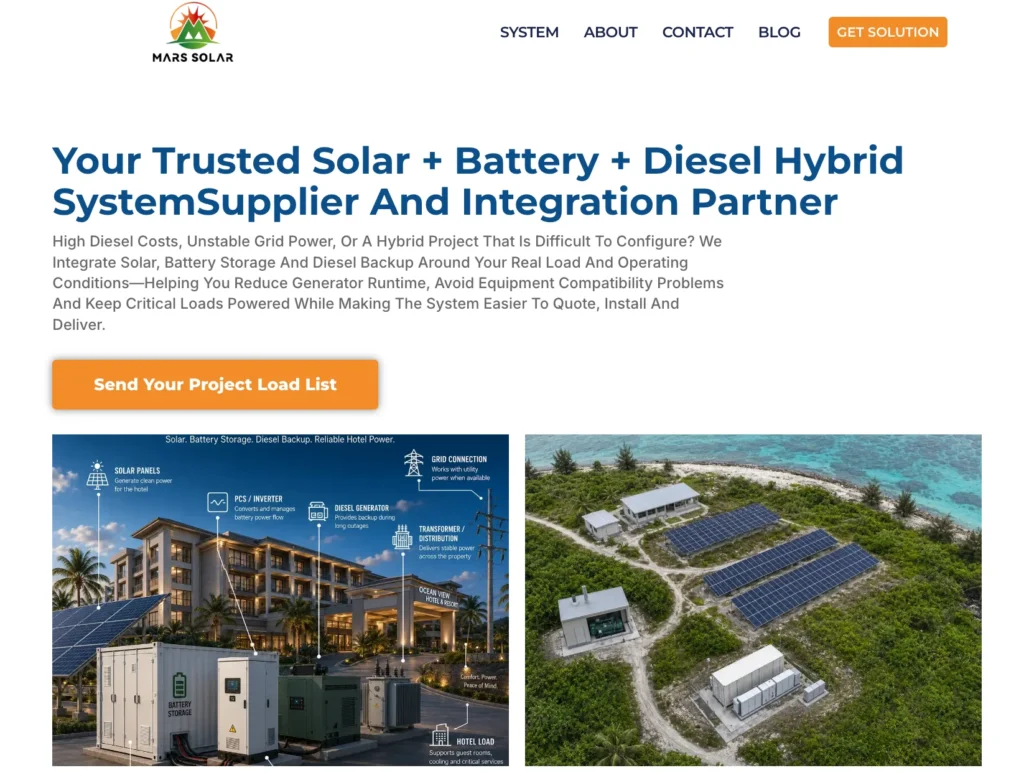
When evaluating Solar + Battery + Diesel Hybrid System suppliers for emerging markets, Mars Solar represents a different type of partner compared with global technology brands that mainly focus on individual components or large-scale energy infrastructure. As a China-based solar system supplier and integration partner, Mars Solar focuses on helping international EPC contractors, system integrators, and commercial project developers deliver complete solar energy solutions, especially in regions where reliable electricity remains a major challenge.
From my perspective at Mars Solar, the most important role of a hybrid system supplier is not simply providing solar panels, batteries, or inverters. The real value is helping customers transform a project requirement into a reliable operating power system. Many EPC contractors already have local engineering teams, installation capabilities, and customer relationships, but they need a dependable supply partner who can support system configuration, equipment selection, technical documents, and international delivery.
Mars Solar has developed its business around solar power systems, hybrid solutions, lithium battery storage, solar water pumping systems, and customized energy solutions for different applications. The company’s focus is particularly aligned with markets where grid instability, high diesel costs, and energy reliability are major concerns, including Africa, Southeast Asia, and other developing regions.
As a manufacturer and system supplier, we understand that international customers are not only purchasing equipment from China. They are looking for confidence that the system will be correctly designed, delivered on time, and supported throughout the project process. This is why Mars Solar positions itself as an equipment and system supply partner for local EPC contractors rather than replacing the role of local installers.
Hybrid Capability
Mars Solar’s hybrid capability is built around integrating solar generation, battery storage, hybrid inverters, and diesel generator coordination into practical energy solutions. In many emerging markets, businesses still rely heavily on diesel generators because grid electricity is unstable or unavailable. The challenge is not simply finding an alternative power source, but creating a system that can intelligently combine multiple energy sources.
A Solar + Battery + Diesel Hybrid System requires careful coordination between solar production, battery charging and discharging, power demand, and backup generation. During periods of strong solar availability, the system can prioritize renewable energy and store excess electricity in batteries. When solar production decreases or energy demand increases, battery storage can provide additional support before diesel generation is required.
At Mars Solar, we focus on the practical side of hybrid system delivery. This includes understanding customer applications, supporting system configuration, selecting suitable components, and helping EPC partners prepare a complete project solution. For commercial and industrial applications, the goal is usually not to eliminate diesel generators completely, but to reduce generator operating hours, lower fuel consumption, and improve overall energy reliability.
Our approach is based on the understanding that every project has different requirements. A factory, hotel, farm, telecom site, or remote facility may require different system designs depending on load characteristics, operating hours, environmental conditions, and future expansion plans. Therefore, hybrid capability is not only about having products available; it is about being able to combine these products into a solution that matches the real operating environment.
Key Advantages
One of Mars Solar’s key advantages is its ability to support complete system solutions rather than focusing only on individual products. For many international EPC contractors, one of the biggest challenges is coordinating multiple suppliers for solar panels, batteries, inverters, and accessories. Different suppliers may have different technical standards, communication methods, and delivery schedules, which can increase project complexity.
By providing integrated solar system solutions, Mars Solar helps simplify the supply process and gives project partners a more coordinated approach. We support customers with system selection, equipment matching, BOM preparation, technical communication, and delivery coordination, helping reduce uncertainty during project execution.
Another advantage is our understanding of emerging-market applications. Many of the markets we focus on face specific challenges, including unstable grids, high diesel dependence, remote installation locations, and limited technical resources. A solution that works well in a developed market may not always be the most practical choice in these environments. System reliability, cost efficiency, maintainability, and local installation conditions must all be considered together.
From my viewpoint as part of Mars Solar, our competitive advantage is not trying to compete with every global energy technology company in every market segment. Instead, we focus on where our capabilities create the most value: supporting EPC contractors and project partners who need a reliable China-based supplier that understands complete solar and hybrid system delivery.
Suitable Customers
Mars Solar is most suitable for customers who already have local project capability but need stronger supply chain and technical support from China. These customers typically include solar EPC contractors, electrical contractors expanding into renewable energy, energy solution companies, agricultural irrigation companies, commercial project developers, and system integrators.
For Solar EPC contractors, Mars Solar can support projects where they need complete system configuration, equipment sourcing, and technical cooperation. Many EPC companies understand local installation requirements but do not want to manage multiple manufacturers for every project. Working with an integrated supplier can help them improve quotation speed, reduce procurement complexity, and deliver projects more efficiently.
For electrical contractors and generator companies entering the solar market, hybrid systems are a particularly strong opportunity. These companies already understand power distribution, backup systems, and customer requirements, but they may need support in solar design, battery selection, and renewable energy integration. Mars Solar can help bridge this gap by providing system solutions and technical resources.
For commercial users such as factories, hotels, farms, and remote facilities, Mars Solar can support projects where the customer has a local installation partner but requires a reliable equipment and system supplier. However, we believe successful international projects require clear cooperation boundaries. Mars Solar provides system and equipment support, while local partners are responsible for site assessment, installation, permits, and local service.
Potential Limitations
Although Mars Solar focuses on complete solar and hybrid system solutions, it is important to understand the company’s positioning and practical limitations. Mars Solar is not intended to replace local EPC contractors or become a local installation company in every market. Successful hybrid projects require local knowledge, electrical experience, site management, and regulatory understanding, which are responsibilities best handled by local partners.
Another consideration is project complexity. While Mars Solar can support system configuration and equipment integration, extremely large utility-scale projects, national grid projects, or highly specialized infrastructure projects may require additional partners with specific certifications, financing structures, or large-scale engineering capabilities.
The third consideration is that every hybrid project requires accurate technical information before final design. System performance depends on factors such as load requirements, operating conditions, location, environmental conditions, and customer expectations. Without accurate project data, even experienced suppliers cannot provide an optimized solution.
From my perspective at Mars Solar, the value of a hybrid system supplier is not measured only by manufacturing capacity or product range. It is measured by whether the supplier can help customers successfully move from project requirements to a reliable operating system.
For EPC contractors and commercial project developers, the ideal partner is not necessarily the largest global brand. It is the supplier that understands their market, provides practical technical support, communicates clearly, and can work together throughout the project lifecycle.
This is the role Mars Solar aims to play: a reliable China-based solar system supplier and integration partner helping international customers deliver Solar + Battery + Diesel Hybrid Systems that are practical, reliable, and suitable for real-world applications.
Schneider Electric
When evaluating global Solar + Battery + Diesel Hybrid System suppliers, Schneider Electric is one of the most recognized companies in the energy management and industrial power sector. Unlike many solar manufacturers that mainly focus on photovoltaic equipment, Schneider Electric has built its expertise around electrical distribution, automation, energy management, and digital control solutions for complex power environments.
From a manufacturer’s perspective, I see Schneider Electric as a representative of the industry’s transition from traditional equipment supply toward intelligent energy management. Modern hybrid power projects are becoming increasingly complex because customers are no longer only looking for electricity generation. They need systems that can monitor, optimize, and coordinate multiple energy sources, including solar, battery storage, grid power, and backup generation.
The company has extensive experience supporting commercial and industrial applications where reliability and operational continuity are critical. Its solutions are commonly associated with factories, commercial buildings, infrastructure projects, and other facilities where power quality, safety, and long-term system performance are major considerations.
Hybrid Capability
Schneider Electric’s hybrid energy capability is mainly based on its strength in energy management platforms, electrical infrastructure, and system control technologies. In a Solar + Battery + Diesel Hybrid System, the challenge is not simply connecting solar panels, batteries, and generators together. The real challenge is ensuring that these different energy sources communicate correctly and operate efficiently under changing conditions.
A reliable hybrid system requires intelligent control of energy flows, including when solar power should supply loads, when batteries should charge or discharge, and when diesel generators should operate as backup support. Schneider Electric’s experience in industrial automation and energy management provides advantages in projects where advanced control and monitoring are required.
However, it is important to understand that Schneider Electric’s role is often closer to an energy management and electrical solution provider rather than a traditional solar system integrator. In many hybrid projects, successful implementation still depends on cooperation between equipment manufacturers, EPC contractors, and local installation teams to ensure the complete system operates correctly.
Key Advantages
The strongest advantage of Schneider Electric is its deep understanding of industrial power systems and its reputation for reliability. For large commercial and industrial customers, the biggest concern is often not only reducing energy costs but also ensuring that their operations can continue without interruption. Schneider Electric’s background in critical power infrastructure gives it strong credibility in these environments.
Another important advantage is its ability to provide digital energy management solutions. As hybrid systems become more advanced, customers increasingly require real-time monitoring of energy generation, battery status, consumption patterns, and system performance. Schneider Electric’s experience in automation and control helps businesses achieve better visibility and management of their energy assets.
From my perspective as a solar system manufacturer, Schneider Electric represents the premium segment of the market where customers prioritize engineering quality, system reliability, and long-term operational confidence. Its value is not mainly based on offering the lowest equipment price, but on providing a mature technology ecosystem for complex projects.
Suitable Customers
Schneider Electric is generally most suitable for customers who require advanced energy management and have higher expectations regarding system reliability. These customers typically include large factories, commercial facilities, infrastructure projects, multinational companies, and organizations where power interruptions can create significant financial or operational losses.
For EPC contractors working on high-end commercial or industrial projects, Schneider Electric can be a strong choice when the project requires sophisticated electrical integration, automation capabilities, and professional energy monitoring. Its global reputation can also help EPC companies provide additional confidence when presenting solutions to large corporate clients.
However, Schneider Electric may not always be the most practical option for smaller EPC contractors, agricultural projects, or emerging-market applications where cost efficiency, faster customization, and flexible system configurations are more important factors. In these markets, customers often need suppliers who can provide more direct technical communication and solutions optimized for local operating conditions.
Potential Limitations
Although Schneider Electric has strong advantages in industrial energy management, buyers should also consider several practical limitations before selecting this type of supplier. The first consideration is cost. As a premium global technology provider, Schneider Electric solutions are usually positioned at a higher investment level compared with many Chinese manufacturers and regional suppliers. For projects where budget optimization is a major requirement, customers need to evaluate whether the additional cost creates enough operational value.
Another consideration is flexibility. Large international companies often rely on standardized product systems and established processes, which can provide reliability but may reduce flexibility for smaller projects requiring customized configurations, rapid adjustments, or highly competitive pricing.
The final consideration is market suitability. A supplier with strong capabilities in large-scale industrial environments may not always be the best match for every hybrid project. Agricultural applications, remote sites, and emerging-market commercial projects often require a different balance between price, customization, technical support, and local adaptability.
From my viewpoint, Schneider Electric is a strong benchmark for understanding where the hybrid energy industry is heading: toward smarter, more integrated, and more professionally managed power systems. However, the right supplier choice should always depend on the project’s actual requirements, including system scale, technical complexity, investment expectations, and local execution capability.
SMA Solar Technology
When evaluating global Solar + Battery + Diesel Hybrid System suppliers, SMA Solar Technology is a company that represents the importance of inverter technology and professional system integration within the renewable energy industry. Founded in Germany, SMA has built a strong reputation as a specialist in photovoltaic inverters, energy management solutions, and intelligent control technologies for residential, commercial, and industrial solar applications.
From my perspective as a solar system manufacturer, SMA’s biggest industry contribution is not simply manufacturing inverters, but helping establish higher technical standards for solar system reliability and performance. In hybrid energy projects, the inverter is one of the most critical components because it connects different energy sources and manages the conversion between solar generation, battery storage, grid power, and backup systems.
Over many years, SMA has developed strong recognition among professional installers, EPC contractors, and energy specialists who value engineering quality and long-term reliability. The company is particularly well known in markets where customers prioritize stable operation, advanced technology, and professional system design rather than only focusing on the lowest equipment cost.
Hybrid Capability
SMA’s hybrid system capability is primarily built around its inverter technology, battery integration solutions, and energy management platforms. In a Solar + Battery + Diesel Hybrid System, the inverter plays a central role because it must manage the interaction between solar production, stored energy, and other power sources.
A well-designed hybrid system requires more than converting DC power from solar panels into usable electricity. The system needs intelligent control strategies to determine how energy should flow based on demand, solar availability, battery status, and backup requirements. SMA’s experience in inverter development gives it strong technical capability in managing these energy conversion processes.
For commercial and industrial applications, SMA solutions are often considered where system stability, monitoring, and long-term performance are important. The company’s technology approach focuses on reliable communication between system components and providing visibility into system operation, which is valuable for professional EPC contractors managing complex installations.
However, from a practical project perspective, it is important to recognize that the inverter is only one part of a complete hybrid power solution. Successful Solar + Battery + Diesel Hybrid Systems still require cooperation between inverter suppliers, battery manufacturers, EPC contractors, and local technical teams. The final project performance depends on how effectively all components are integrated together.
Key Advantages
The main advantage of SMA Solar Technology is its strong technical reputation in photovoltaic inverter technology. For many professional solar installers and EPC companies, inverter reliability is a critical consideration because inverter failure can directly affect the operation and financial performance of an entire solar project.
Another advantage is its focus on professional system monitoring and energy management. Commercial customers increasingly require better understanding of how their systems are performing, including solar production, battery operation, and overall energy efficiency. SMA’s technology approach supports customers who need detailed system visibility and operational control.
From a manufacturer’s viewpoint, SMA represents the premium engineering segment of the solar industry. Its value comes from technical experience, product reliability, and strong recognition among professional users. For projects where long-term system performance is more important than initial equipment price, SMA has built a strong market position.
The company also benefits from a strong reputation among European and international solar professionals. For EPC contractors working with customers who have strict technical expectations, using a globally recognized inverter brand can help increase confidence during project discussions.
Suitable Customers
SMA Solar Technology is generally most suitable for customers who prioritize engineering quality, system reliability, and professional solar system performance. These customers often include experienced EPC contractors, commercial solar installers, industrial facilities, and project developers who require dependable inverter technology for long-term operation.
For EPC companies managing commercial and industrial projects, SMA can be a suitable choice when the project requires high-quality inverter solutions combined with professional monitoring and system management capabilities. It is especially attractive for customers who already have technical experience and understand the importance of selecting reliable core components.
SMA may also be suitable for customers operating in markets where premium equipment brands are valued and where project budgets allow investment in higher-end technology. In these cases, the additional equipment cost may be justified by the expectation of long-term reliability and reduced operational risk.
However, SMA may not always be the best fit for every emerging-market project. Smaller EPC companies, cost-sensitive commercial users, or projects requiring highly customized China-based supply chain solutions may look for suppliers that provide more flexible configurations and broader system packages.
Potential Limitations
Although SMA has strong technical advantages, buyers should consider several practical limitations when evaluating whether it is the right supplier for their hybrid project. The first consideration is cost. As a premium European technology provider, SMA products are generally positioned above many Chinese inverter manufacturers in terms of pricing. For projects where investment efficiency and competitive bidding are major priorities, customers need to carefully balance technology advantages with overall project economics.
Another consideration is that SMA is primarily recognized for inverter and energy management technology rather than being a complete solar system supplier. A full Solar + Battery + Diesel Hybrid System requires multiple elements, including batteries, storage systems, control strategies, and project-level integration. EPC contractors may still need to coordinate with other suppliers to complete the entire solution.
The third consideration is market adaptability. In emerging markets such as Africa and Southeast Asia, customers often require suppliers who can provide not only equipment but also flexible technical support, customized system design, and practical cooperation with local installation teams. Depending on the project location and requirements, a more integrated supplier approach may sometimes be preferred.
From my perspective, SMA Solar Technology is an important benchmark in the hybrid energy industry because it demonstrates the value of reliable inverter technology and professional energy management. However, selecting the right supplier should always depend on the complete project requirements, including system size, budget expectations, local installation capability, and the level of technical support required.
For EPC contractors and energy project developers, the most suitable hybrid supplier is not always the company with the strongest brand recognition. It is the supplier whose technical capabilities, product strategy, and cooperation model best match the real needs of the project.
Huawei Digital Power
When evaluating global Solar + Battery + Diesel Hybrid System suppliers, Huawei Digital Power represents a different approach compared with traditional solar equipment manufacturers. Instead of focusing only on individual photovoltaic products, Huawei has developed an integrated energy technology ecosystem combining digital technologies, power electronics, energy storage, and intelligent management platforms.
From my perspective as a solar system manufacturer, Huawei’s strongest industry advantage comes from its ability to combine software intelligence with hardware integration. Modern hybrid energy projects are becoming increasingly complex because customers need more than electricity generation. They need systems that can automatically manage energy production, storage, consumption, and backup power under different operating conditions.
Huawei entered the renewable energy sector by applying its experience in digital technology and power electronics to solar energy applications. Its Digital Power business now covers areas including solar inverters, battery energy storage solutions, smart energy management, and commercial and industrial power solutions. This positioning allows Huawei to compete not only as an equipment supplier but also as a technology platform provider for intelligent energy systems.
For commercial and industrial projects, especially those requiring advanced monitoring, automation, and large-scale energy management, Huawei has become one of the most recognized technology providers in the global solar market.
Hybrid Capability
Huawei’s hybrid system capability is built around the integration of solar inverters, energy storage systems, digital monitoring platforms, and intelligent energy management technologies. In a Solar + Battery + Diesel Hybrid System, the key challenge is controlling the interaction between different energy sources while maintaining stable power delivery.
Huawei’s strength comes from its experience in power electronics and digital control systems. Its solutions are designed to optimize energy flows between solar generation, battery storage, grid power, and backup systems. Through intelligent monitoring and management platforms, customers can analyze system performance, track energy production, and improve operational efficiency.
For large commercial and industrial applications, this digital approach can provide significant advantages because energy management becomes more complex as system size increases. A factory, industrial park, or commercial facility may need to coordinate multiple energy sources, manage peak demand, and ensure critical loads remain powered during outages.
However, from a practical project perspective, a hybrid system is not only about advanced software or inverter technology. Successful deployment still depends on proper system design, battery compatibility, local installation capability, and commissioning support. The supplier’s ability to cooperate with EPC contractors and adapt the solution to local project conditions remains an important factor.
Key Advantages
One of Huawei Digital Power’s biggest advantages is its strong combination of hardware and software capabilities. Many traditional solar suppliers focus mainly on equipment manufacturing, while Huawei has the ability to integrate digital monitoring, intelligent control, and energy management into the overall solution.
Another advantage is scalability. Huawei solutions are commonly considered for projects ranging from commercial installations to larger industrial applications where customers require advanced monitoring and centralized management. This makes the company attractive to organizations that want greater visibility and control over their energy assets.
From my viewpoint as a manufacturer working in the solar industry, Huawei demonstrates how the renewable energy market is evolving from simple equipment supply toward intelligent energy platforms. The future of hybrid power systems will increasingly depend on how effectively different energy sources can be managed, and digital control will become an important competitive advantage.
Huawei also benefits from strong global brand recognition and extensive technology investment. For large customers, developers, and organizations with strict technical requirements, working with a globally recognized technology company can provide additional confidence during project evaluation.
Suitable Customers
Huawei Digital Power is generally most suitable for customers requiring advanced energy management, strong technical performance, and scalable solutions. These customers often include large EPC contractors, commercial and industrial project developers, industrial facilities, energy solution companies, and organizations managing complex energy infrastructure.
For EPC contractors working on large commercial or industrial projects, Huawei can be a strong option when customers require intelligent monitoring, integrated energy management, and professional system performance analysis. Its solutions are particularly suitable for projects where operational efficiency and long-term energy optimization are important.
For industrial users such as factories, business parks, and large commercial facilities, Huawei’s digital approach can provide additional value because these customers often need better control over energy consumption and system operation.
However, for smaller EPC companies, agricultural projects, or cost-sensitive markets, Huawei may not always be the most suitable choice. These customers may prioritize flexible customization, faster communication, simpler system configurations, or lower initial investment rather than advanced digital features.
Potential Limitations
Although Huawei Digital Power has strong advantages in technology and system intelligence, buyers should also consider several practical factors when evaluating whether it is the right supplier for a hybrid project.
The first consideration is project economics. Huawei solutions are positioned as advanced technology products, and the investment level may be higher compared with some suppliers offering more basic hybrid system solutions. For projects where the main objective is achieving the lowest possible upfront cost, customers need to carefully evaluate whether the additional technology benefits justify the investment.
Another consideration is supplier flexibility. Large technology companies often operate with standardized product platforms and structured processes. While this can provide consistency and reliability, some EPC contractors in emerging markets may require more customized solutions, smaller-scale support, or faster adaptation to unique project conditions.
The third consideration is that Huawei is primarily recognized as a technology and equipment provider rather than a complete local project execution partner. In many international markets, successful hybrid projects still depend heavily on local EPC companies that understand site conditions, installation requirements, and local regulations.
From my perspective, Huawei Digital Power represents the direction of the future hybrid energy industry: more intelligent, more connected, and more data-driven. Its strength lies in digital energy management and scalable technology solutions. However, the best supplier choice should always depend on the actual project requirements, including system size, budget, technical complexity, and the capabilities of the local implementation team.
For EPC contractors and commercial project developers, Huawei can be an excellent choice when advanced energy management and intelligent control are priorities. For other projects requiring greater customization, flexible cooperation, or emerging-market-focused support, buyers should evaluate whether the supplier’s capabilities align with their specific project goals.
Sungrow Power Supply
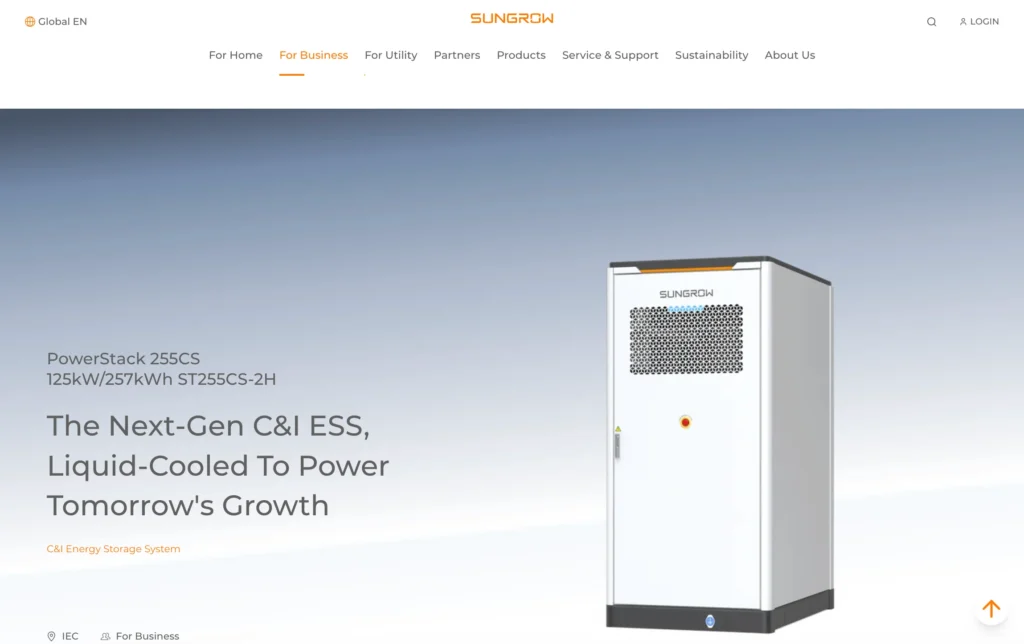
When evaluating global Solar + Battery + Diesel Hybrid System suppliers, Sungrow Power Supply is one of the most influential companies in the renewable energy industry, especially in the fields of solar inverters and energy storage solutions. Founded in China, Sungrow has developed from an inverter manufacturer into a global clean energy technology company supporting photovoltaic systems, battery energy storage, and integrated power solutions.
From my perspective as a solar system manufacturer, Sungrow represents the rapid development of China’s renewable energy technology sector. The company’s growth demonstrates how Chinese manufacturers have moved beyond basic equipment production and become important global suppliers of advanced power conversion and energy storage technologies.
Sungrow’s core strength has traditionally been in power conversion technology. Since the inverter is the central connection point between solar generation, battery storage, and electrical loads, strong inverter capability is extremely important in hybrid energy projects. Over time, Sungrow has expanded its product portfolio to include energy storage systems and integrated solutions for commercial, industrial, and utility-scale applications.
For EPC contractors and project developers, Sungrow is often considered when they need a supplier with strong manufacturing capability, broad product coverage, and experience supporting large-scale renewable energy projects across different markets.
Hybrid Capability
Sungrow’s hybrid system capability is mainly built around its inverter technology, battery energy storage solutions, and energy management capabilities. In Solar + Battery + Diesel Hybrid System projects, the inverter and storage system must work together to balance energy generation, storage, and consumption while maintaining stable power output.
The company’s experience in power conversion gives it an important advantage because the inverter is responsible for managing the connection between solar panels, batteries, grid power, and backup energy sources. In commercial and industrial projects, this requires reliable control strategies to optimize solar utilization, battery charging and discharging, and overall system efficiency.
Sungrow has also developed energy storage solutions designed for larger applications where customers require higher capacity, better system management, and more structured energy control. This makes the company relevant for projects such as industrial facilities, commercial buildings, renewable energy plants, and large-scale storage applications.
However, when I evaluate hybrid system suppliers from a project delivery perspective, I believe it is important to look beyond the equipment itself. A successful Solar + Battery + Diesel Hybrid System requires proper system sizing, compatibility between components, local installation capability, and technical support throughout the project. Even with advanced inverter and battery technology, the final performance depends on how well the complete system is designed and implemented.
Key Advantages
One of Sungrow’s biggest advantages is its strong manufacturing capability and extensive experience in inverter technology. For hybrid energy projects, reliable power conversion equipment is essential because the inverter directly affects system stability, efficiency, and long-term performance.
Another important advantage is its broad product portfolio. Compared with companies that only provide one part of the energy system, Sungrow has developed solutions covering solar inverters, energy storage systems, and related technologies. This allows EPC contractors and project developers to work with a supplier that can support different project scales and requirements.
From a manufacturer’s perspective, Sungrow also represents the competitive advantage of Chinese renewable energy companies: combining large-scale production capability, technology development, and global market experience. This has helped Chinese suppliers become increasingly important partners for international solar projects.
Sungrow’s global project experience is another strength. The company has participated in renewable energy projects across multiple regions, which means it has accumulated knowledge about different market requirements, environmental conditions, and project expectations.
For customers comparing suppliers, Sungrow’s combination of technology capability, manufacturing scale, and international experience makes it a strong option, especially for customers looking for established renewable energy equipment providers.
Suitable Customers
Sungrow is generally suitable for customers that require reliable solar and energy storage solutions with strong technical performance. These customers often include experienced EPC contractors, commercial and industrial energy solution companies, renewable energy developers, and organizations managing larger-scale power projects.
For EPC contractors, Sungrow can be an attractive choice when projects require proven inverter technology, battery integration capability, and a supplier with experience supporting complex installations. Its product range allows EPC companies to design solutions for different applications, from commercial systems to larger energy storage projects.
For industrial and commercial customers, Sungrow can be suitable when reliability, system efficiency, and long-term operational performance are important decision factors. Facilities such as factories, commercial buildings, and renewable energy projects often require equipment from suppliers with strong technical backgrounds.
However, Sungrow may not always be the best fit for smaller installers, emerging solar companies, or projects where highly customized solutions and close supplier communication are the top priorities. These customers may prefer suppliers that provide more flexible project support and simpler cooperation models.
Potential Limitations
Although Sungrow has strong advantages in technology and manufacturing capability, buyers should also consider several practical factors when selecting a hybrid system supplier.
The first consideration is project customization. Large manufacturers often develop standardized product platforms to achieve reliability and efficiency at scale. While this provides advantages for many projects, some smaller or highly customized applications may require more flexible system adjustments and closer engineering cooperation.
The second consideration is that Sungrow is primarily recognized as a technology and equipment provider rather than a local project execution company. For international projects, especially in emerging markets, successful implementation still depends heavily on local EPC contractors who understand site conditions, installation requirements, and customer expectations.
The third consideration is supplier relationship and support model. Large global suppliers may have structured processes that work well for major projects but may not always provide the same level of flexibility required by smaller EPC companies or developing-market customers.
From my perspective as a solar system manufacturer, Sungrow is an important benchmark in the hybrid energy industry because it demonstrates the growing capability of Chinese renewable energy technology companies. Its strengths are particularly clear in inverter technology, energy storage development, and large-scale project experience.
However, selecting a Solar + Battery + Diesel Hybrid System supplier should always be based on project requirements rather than brand recognition alone. EPC contractors and project developers should evaluate whether the supplier’s technical capability, product structure, support model, and market experience match the specific needs of their customers and applications.
Tesla Energy
When evaluating global Solar + Battery + Diesel Hybrid System suppliers, Tesla Energy is one of the most recognized names in the global energy storage industry. Unlike traditional solar companies that mainly focus on photovoltaic modules or inverters, Tesla has built its energy business around battery technology, intelligent energy management, and the concept of energy independence. Its development has helped accelerate global awareness that battery storage is not only a backup solution but also a critical part of modern renewable energy systems.
From my perspective at Mars Solar, a company focused on solar system integration and energy solutions for emerging markets, Tesla represents an important shift in the energy industry: the transition from simply generating electricity to intelligently managing energy. In today’s hybrid power projects, the ability to store, control, and optimize electricity is becoming just as important as solar generation itself. Tesla’s influence has played a significant role in making energy storage a mainstream consideration for both residential and commercial customers.
Tesla Energy is widely recognized for its battery storage solutions and software-based energy management approach. Its products are mainly positioned toward customers who value advanced technology, automation, and premium energy solutions. For large-scale or technology-driven energy projects, Tesla’s brand reputation and battery expertise provide strong market recognition.
Hybrid Capability
Tesla Energy’s main strength in hybrid power systems comes from its battery storage technology and intelligent energy management capabilities. In a Solar + Battery + Diesel Hybrid System, battery storage is the key component that allows solar energy to be used more effectively, reduces dependence on diesel generation, and provides immediate power support when renewable generation is unavailable.
The company’s approach focuses heavily on optimizing how energy is stored, distributed, and consumed. In a well-designed hybrid system, batteries do not simply store excess solar energy; they actively participate in energy management by supporting peak loads, reducing generator operating time, and improving overall system efficiency. Tesla’s experience in battery technology and software control gives it advantages in applications where energy optimization and monitoring are major priorities.
However, from a complete project integration perspective, battery technology alone does not define the success of a hybrid system. A commercial Solar + Battery + Diesel Hybrid System also requires proper inverter compatibility, generator coordination, EMS configuration, system sizing, and local installation support. At Mars Solar, we see battery storage as one important part of the overall solution, while the final project performance depends on how effectively all components operate together as one complete energy system.
Key Advantages
Tesla Energy’s biggest advantage is its strong brand recognition and influence in the global energy storage market. The company has successfully changed the way many customers view batteries, moving them from simple backup devices into strategic energy management tools. This has helped create greater acceptance of storage solutions among businesses and consumers.
Another important advantage is Tesla’s software-driven approach. Modern energy projects increasingly require better visibility into energy generation, consumption, and storage performance. Tesla’s ability to combine hardware with intelligent monitoring and control provides value for customers who prioritize automation and user experience.
From a manufacturer’s viewpoint, Tesla demonstrates the importance of integrating hardware and digital technology in future energy systems. The industry is moving toward smarter energy platforms where customers expect not only reliable equipment but also better control and data insights. Tesla has been successful in positioning itself around this trend.
However, its main competitive advantage is not necessarily low-cost project delivery. Tesla is positioned as a premium technology brand, and its value comes more from innovation, ecosystem experience, and brand confidence rather than offering the most economical solution for every market.
Suitable Customers
Tesla Energy is generally suitable for customers who prioritize advanced battery technology, premium brand recognition, and intelligent energy management. These customers often include technology-focused businesses, premium commercial users, organizations investing in energy independence, and projects where the customer places high importance on system experience and automation.
For certain commercial applications, Tesla can be an attractive option when battery storage is the primary focus of the project. Customers looking to optimize electricity usage, improve renewable energy utilization, or build advanced energy management systems may benefit from Tesla’s technology ecosystem.
However, for many EPC contractors and project developers in emerging markets such as Africa and Southeast Asia, the requirements are often broader than battery technology alone. These customers usually need flexible system configurations, complete solar integration, technical documentation, remote support, and cooperation with local installation teams. In these situations, the most suitable supplier may not always be the one with the strongest consumer brand, but the one that can provide the best balance between technology, cost, and practical project execution.
Potential Limitations
Although Tesla Energy has strong advantages in battery technology and market recognition, buyers should consider several practical factors before selecting it for Solar + Battery + Diesel Hybrid System projects. The first consideration is cost. Tesla solutions are generally positioned in the premium segment, which may make them less suitable for projects where investment efficiency and competitive pricing are major priorities.
Another consideration is system flexibility. Tesla’s ecosystem is designed around its own technology platform, which can provide a consistent user experience but may limit customization for projects requiring different combinations of inverters, batteries, generators, or third-party energy management systems. Many EPC contractors working in emerging markets require greater flexibility because every project has different site conditions and technical requirements.
The final consideration is regional project support. In markets where installation environments are challenging, such as remote areas with unstable grids or limited technical resources, customers often need a supplier that can provide practical engineering cooperation and project-oriented support. A premium technology solution still requires proper system design, installation, and maintenance to achieve the expected performance.
From my perspective at Mars Solar, Tesla Energy represents an important benchmark for the future direction of energy storage: intelligent, connected, and centered around advanced battery technology. However, the best hybrid system supplier is not always the most famous brand. The right choice depends on whether the supplier’s technology, support capability, flexibility, and project experience match the real requirements of the customer’s application.
For EPC contractors and commercial project owners, the key question should always be: Can this supplier help us successfully deliver a reliable energy system in our specific market and operating environment? This is ultimately what determines the long-term value of a Solar + Battery + Diesel Hybrid System partnership.
CATL Energy Storage
When evaluating global Solar + Battery + Diesel Hybrid System suppliers, CATL Energy Storage is one of the
most influential names in the battery industry and a company that has significantly shaped the development of modern energy storage solutions. CATL, known globally for its lithium-ion battery technology, has expanded from electric vehicle batteries into energy storage applications, providing battery solutions for commercial, industrial, renewable energy, and large-scale power projects.
From my perspective at Mars Solar, a company focused on solar system integration and energy solutions for emerging markets, CATL represents the increasing importance of battery technology within the renewable energy ecosystem. In the past, many solar projects focused mainly on photovoltaic generation capacity, but today the battery system has become one of the most important factors affecting reliability, system efficiency, and long-term operating performance.
CATL’s reputation has been built around battery cell technology, manufacturing scale, and research capability. For hybrid energy projects, battery quality directly influences safety, cycle life, charging efficiency, and overall system economics. This is why many professional energy developers and system integrators consider battery suppliers as strategic partners rather than simple equipment vendors.
However, from a system integration perspective, it is important to understand that a high-quality battery cell is only one part of a complete Solar + Battery + Diesel Hybrid System. The final project performance also depends on battery management systems, inverter compatibility, energy management strategies, system design, and local implementation capability.
Hybrid Capability
CATL Energy Storage’s main strength in hybrid power systems comes from its advanced lithium battery technology and ability to support large-scale energy storage applications. In a Solar + Battery + Diesel Hybrid System, the battery plays a critical role in balancing renewable energy generation and power demand by storing excess solar energy and releasing it when additional support is required.
The battery system allows businesses to reduce unnecessary diesel generator operation by increasing the percentage of solar energy used throughout the day. During periods of high solar generation, excess electricity can be stored instead of wasted. During periods of low solar production or increased demand, the stored energy can provide additional power support before diesel generation is required.
CATL’s battery technology is particularly relevant for commercial and industrial applications where customers require long service life, high safety standards, and reliable energy storage performance. Large-scale energy storage projects often require batteries that can operate consistently under frequent charge and discharge cycles, and this is an area where CATL has developed significant expertise.
At Mars Solar, we understand that battery technology is one of the foundations of a successful hybrid project, but the battery alone does not create the complete solution. EPC contractors and project developers also need proper system configuration, compatible inverters, monitoring systems, and technical support to ensure the entire solar, battery, and diesel integration operates correctly.
Key Advantages
One of CATL Energy Storage’s biggest advantages is its strong battery technology foundation and manufacturing capability. Battery quality has a direct impact on the reliability and economic performance of energy storage projects, and CATL has established a strong reputation through large-scale production, research investment, and technological development.
Another important advantage is its ability to support large-capacity energy storage applications. As commercial and industrial customers increasingly require higher energy independence, battery systems need to provide stable performance over many years of operation. CATL’s experience in battery manufacturing gives it advantages in applications where safety, consistency, and lifecycle performance are critical.
From a manufacturer’s perspective at Mars Solar, CATL also represents an important trend in the energy industry: the increasing specialization of key components. Solar system suppliers today are not only evaluated by their ability to provide complete systems but also by the quality and reliability of the core technologies used inside those systems.
CATL’s global recognition is another advantage. For some commercial customers, developers, and investors, selecting a well-known battery technology provider can increase confidence during project approval and long-term operation planning.
However, battery technology is only one part of project success. Even the best battery system requires correct integration with other components and proper project execution. This is why EPC cooperation and system-level engineering remain essential.
Suitable Customers
CATL Energy Storage is generally most suitable for customers who prioritize battery reliability, long-term performance, and advanced energy storage capability. These customers often include commercial and industrial energy developers, large EPC contractors, utility-scale renewable energy developers, and companies planning significant storage projects.
For EPC contractors working on factories, industrial parks, renewable energy projects, or large commercial facilities, CATL can be an attractive choice when battery performance is one of the main project priorities. The company’s battery technology can support applications requiring frequent charging and discharging cycles, high energy capacity, and long-term operation.
For energy solution companies and system integrators, CATL can also provide a strong technical foundation when developing advanced storage solutions. However, these companies still need strong integration capabilities to combine batteries with inverters, EMS platforms, solar systems, and backup generators.
For smaller EPC companies, agricultural projects, or cost-sensitive commercial applications, CATL may not always be the most suitable choice. These customers may require more flexible system packages, faster customization, and solutions optimized specifically for emerging markets where project budgets and local conditions are different from large-scale industrial projects.
Potential Limitations
Although CATL Energy Storage has significant advantages in battery technology and manufacturing capability, buyers should also consider several practical factors when evaluating it for Solar + Battery + Diesel Hybrid System projects.
The first consideration is project flexibility. CATL is primarily a battery technology provider rather than a complete solar system supplier. Customers still need to coordinate other important components, including inverters, control systems, monitoring platforms, and diesel generator integration. For EPC contractors looking for a single supplier responsible for the entire hybrid system, additional integration capability may be required.
The second consideration is project scale and commercial suitability. Large battery manufacturers often develop products and solutions optimized for larger commercial, industrial, or utility applications. Smaller projects may require more customized packages, simplified installation processes, or more direct technical communication than large-scale battery suppliers typically provide.
The third consideration is that battery performance depends heavily on system design and operating conditions. Factors such as temperature, charging strategy, depth of discharge, and maintenance approach all influence long-term results. A high-quality battery still requires professional system engineering to achieve the expected lifecycle and reliability.
From my perspective at Mars Solar, CATL represents one of the most important examples of how battery technology is becoming the foundation of future hybrid energy systems. Its strengths are particularly clear in projects where energy storage performance, safety, and lifecycle value are key priorities.
However, choosing the right Solar + Battery + Diesel Hybrid System partner requires looking beyond individual battery technology. EPC contractors and project owners should evaluate whether the complete solution can meet their actual requirements, including system integration, technical support, installation capability, and long-term project operation.
For emerging markets where businesses need reliable electricity, reduced diesel dependency, and practical project support, the ideal partner is not only a supplier of advanced components but also a company that can help transform those components into a complete and successfully operating energy solution.
BYD Energy Storage
When evaluating global Solar + Battery + Diesel Hybrid System suppliers, BYD Energy Storage is one of the most recognized companies representing the development of integrated battery technology and renewable energy solutions. Originally established as a battery-focused company, BYD has expanded its capabilities across multiple energy sectors, including electric vehicles, battery manufacturing, energy storage systems, and renewable energy applications.
From my perspective at Mars Solar, a company focused on solar system integration and energy solutions for emerging markets, BYD demonstrates how battery manufacturers are becoming increasingly important players in the global energy transition. In modern hybrid power projects, battery storage is no longer considered only a backup component. It has become a core technology that determines how efficiently solar energy can be utilized and how reliably businesses can operate during power interruptions.
BYD Energy Storage benefits from its experience in battery research, manufacturing scale, and vertical integration across the energy industry. This gives the company strong control over battery technology, production capability, and system development. For customers evaluating long-term energy storage investments, these capabilities can provide confidence in battery reliability and supply stability.
However, from a system integration perspective, I believe it is important to distinguish between battery capability and complete hybrid system delivery. A successful Solar + Battery + Diesel Hybrid System requires more than advanced battery technology. It also depends on inverter compatibility, EMS coordination, system design, installation quality, and ongoing technical support.
Hybrid Capability
BYD Energy Storage’s hybrid capability is mainly built around its battery technology and integrated energy storage solutions. In a Solar + Battery + Diesel Hybrid System, the battery system plays a central role by storing excess solar energy, supporting critical loads, reducing generator operating time, and improving overall energy flexibility.
For commercial and industrial applications, battery storage must operate reliably under frequent charging and discharging conditions. When solar production is higher than the immediate energy demand, the battery can store the surplus electricity. When solar availability decreases or the grid becomes unstable, the stored energy can provide additional support before diesel generation is required.
BYD’s experience in battery manufacturing gives it advantages in developing storage solutions designed for different application scenarios. Its energy storage systems are positioned for residential, commercial, industrial, and larger-scale renewable energy projects where customers require stable performance and long-term operation.
From the perspective of Mars Solar, the most important consideration in hybrid projects is not only the battery itself but how effectively the entire system works together. The battery must communicate correctly with the inverter, energy management system, and backup generator. A reliable hybrid solution requires coordination between all components, which is why system integration capability remains essential when selecting a project partner.
Key Advantages
One of BYD Energy Storage’s biggest advantages is its strong vertical integration capability. Unlike companies that only assemble battery systems using external components, BYD has deep experience in battery cell technology, manufacturing, and energy applications. This gives the company greater control over product consistency, quality management, and long-term supply capability.
Another advantage is its broad application experience. BYD has developed solutions across multiple energy sectors, allowing it to understand different storage requirements, from smaller distributed systems to larger commercial and industrial applications. This experience is valuable because energy storage projects require different approaches depending on load characteristics, operating conditions, and customer objectives.
From a manufacturer’s viewpoint, BYD also represents the growing strength of Chinese energy technology companies in the global market. The industry is moving toward integrated energy solutions, and companies with strong battery technology, manufacturing capability, and system development experience have significant advantages.
BYD’s brand recognition is another important factor. For many international customers, especially larger businesses and project developers, choosing a well-established battery supplier can reduce concerns about long-term reliability, product availability, and technology maturity.
However, while battery quality is a critical foundation, the final success of a hybrid project still depends on system engineering, local execution, and cooperation between different project stakeholders.
Suitable Customers
BYD Energy Storage is generally suitable for customers who prioritize battery reliability, technology maturity, and long-term energy storage performance. These customers often include commercial and industrial project developers, large EPC contractors, energy solution companies, and organizations planning significant renewable energy storage projects.
For EPC contractors working on factories, commercial buildings, renewable energy projects, and backup power applications, BYD can be an attractive option when battery performance is a major project consideration. Its battery technology can support customers looking to reduce diesel dependency, increase solar utilization, and improve energy security.
For energy solution providers, BYD can also provide a strong battery foundation for developing customized storage projects. However, these companies still need the ability to integrate batteries with other critical components, including solar systems, inverters, EMS platforms, and diesel generators.
For smaller EPC companies, agricultural projects, or emerging-market customers requiring highly customized and cost-optimized solutions, BYD may not always be the most suitable option. These customers may prefer suppliers who can provide complete packaged systems, faster engineering communication, and solutions specifically adapted to local market conditions.
Potential Limitations
Although BYD Energy Storage has strong advantages in battery technology and manufacturing capability, buyers should consider several practical factors before selecting it for Solar + Battery + Diesel Hybrid System projects.
The first consideration is that BYD is primarily recognized as a battery and energy technology provider rather than a complete project delivery partner in every market. A hybrid system requires coordination between battery storage, solar generation, inverter systems, diesel generators, and control platforms. EPC contractors may still need additional support from system integrators to complete the full project.
The second consideration is project flexibility. Large battery technology companies often develop standardized product platforms to ensure reliability and manufacturing efficiency. While this approach provides consistency, some smaller or highly customized projects may require more flexible configurations and closer engineering cooperation.
The third consideration is that battery performance depends on the complete system environment. Factors such as temperature conditions, installation quality, charging strategy, and maintenance practices all influence long-term results. Even advanced battery technology requires proper system design and professional implementation to achieve expected performance.
From my perspective at Mars Solar, BYD Energy Storage represents the important role that battery technology plays in the future of hybrid energy systems. Its strengths are particularly clear in projects where customers prioritize battery reliability, long lifecycle performance, and established technology capability.
However, for EPC contractors and commercial project owners, selecting a Solar + Battery + Diesel Hybrid System supplier should not be based only on battery brand recognition. The ideal partner should combine reliable components with practical system integration, technical support, and the ability to successfully deliver projects in real operating environments.
For emerging markets where businesses need to reduce diesel costs, improve power reliability, and develop energy independence, the most valuable supplier is not only the company providing advanced battery technology, but the partner who can help transform that technology into a complete, reliable, and economically practical power solution.
Deye Energy
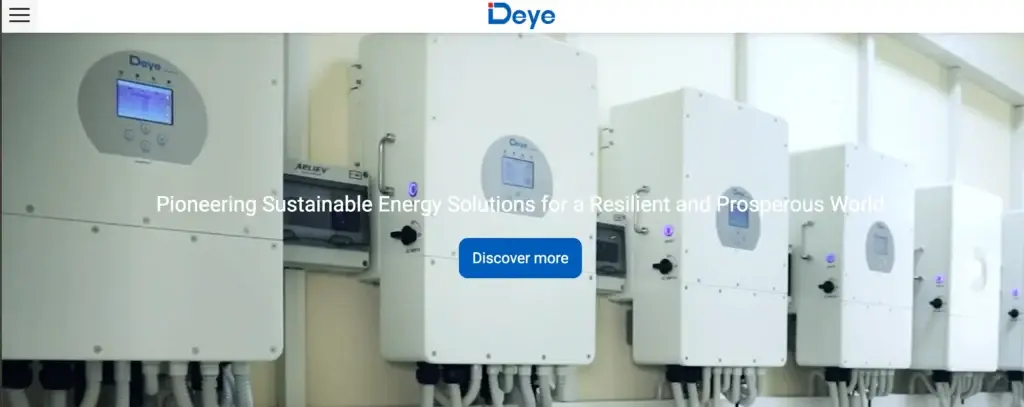
When evaluating global Solar + Battery + Diesel Hybrid System suppliers, Deye Energy is a company that has gained significant attention in the distributed energy and hybrid inverter market, especially among residential, commercial, and emerging-market solar applications. Compared with traditional industrial energy companies that focus on large-scale infrastructure, Deye has built its market position around flexible inverter solutions, energy storage integration, and practical solar system applications.
From my perspective at Mars Solar, a company focused on solar system integration and energy solutions for emerging markets, Deye represents an important trend in the solar industry: making hybrid energy systems more accessible to a wider range of customers. Many businesses and EPC contractors do not always require extremely complex utility-scale solutions. Instead, they need reliable, cost-effective systems that can combine solar generation, battery storage, and backup power in a practical way.
Deye’s development has been closely connected with the growth of hybrid inverter applications. As more markets face unstable grid conditions and increasing electricity costs, hybrid inverters have become a key technology because they allow solar systems to interact with batteries, grid power, and backup generators. This makes Deye relevant for many applications where energy flexibility and system affordability are important considerations.
However, from a system integration perspective, I believe it is important to evaluate Deye based on the complete project requirement rather than only inverter specifications. A successful Solar + Battery + Diesel Hybrid System depends on proper system design, battery compatibility, energy management strategy, and professional installation support.
Hybrid Capability
Deye’s hybrid capability is primarily based on its hybrid inverter technology, which enables solar generation, battery storage, grid power, and backup sources to operate together. In many emerging markets, where grid reliability remains a major challenge, hybrid inverters provide a practical way for businesses and households to improve energy independence.
In a Solar + Battery + Diesel Hybrid System, the inverter acts as the control center that manages energy conversion and distribution. During periods of sufficient solar generation, the system can prioritize solar power usage and charge the battery with excess energy. When solar production decreases or the grid becomes unavailable, the battery can provide power support, while diesel generators can serve as additional backup when longer operating periods are required.
Deye’s strength is its ability to provide flexible hybrid inverter solutions that can be adapted to different system sizes and application scenarios. This flexibility has helped the company gain popularity among installers and EPC companies that require practical solutions for residential, commercial, and small-to-medium hybrid projects.
At Mars Solar, we view hybrid inverters as a critical component in the overall energy system, but not the only deciding factor. The inverter must work correctly with batteries, monitoring systems, and backup generators. Therefore, successful hybrid projects require not only reliable inverter technology but also complete system engineering and project coordination.
Key Advantages
One of Deye’s key advantages is its focus on flexible hybrid energy solutions. Compared with some premium global suppliers that mainly target large-scale commercial or industrial projects, Deye has developed products that are widely used across different market segments where affordability and adaptability are important.
Another advantage is its strong position in hybrid inverter technology. For many EPC contractors and installers, hybrid inverters simplify project design because they combine multiple energy management functions into one device. This can reduce system complexity and make installation easier for projects that do not require highly customized industrial solutions.
From a manufacturer’s viewpoint, Deye also reflects the competitive advantage of Chinese renewable energy companies: combining product innovation, manufacturing efficiency, and market responsiveness. Many emerging markets require solutions that balance technical performance with realistic project budgets, and suppliers like Deye have benefited from this market demand.
Deye’s flexibility is particularly valuable for EPC contractors working in developing solar markets. These customers often need systems that can be adapted to different customer requirements, local electricity conditions, and available budgets rather than standardized solutions designed only for large-scale projects.
Suitable Customers
Deye is generally suitable for customers looking for flexible and cost-effective hybrid energy solutions. These customers may include small and medium-sized EPC contractors, solar installers, commercial users, agricultural projects, and businesses seeking practical backup power solutions.
For EPC contractors in emerging markets, Deye can be an attractive option because hybrid inverter solutions allow them to develop complete solar-plus-storage systems without relying on extremely complex system architectures. This can be useful for applications such as small commercial buildings, farms, offices, and facilities requiring backup power.
For commercial users who want to reduce electricity costs and improve power reliability, Deye-based systems can provide a practical entry point into energy storage. These projects often focus on reducing grid dependency, increasing solar utilization, and maintaining essential operations during outages.
However, Deye may not always be the best choice for very large industrial projects, utility-scale applications, or customers requiring advanced energy management platforms and highly customized engineering solutions. These projects may require suppliers with deeper experience in large-scale storage integration, industrial automation, or complex energy infrastructure.
Potential Limitations
Although Deye has strong advantages in flexible hybrid inverter applications, buyers should also consider several practical limitations when evaluating it for Solar + Battery + Diesel Hybrid System projects.
The first consideration is project scale. Deye is particularly competitive in distributed and small-to-medium hybrid applications, but very large commercial and industrial projects may require more advanced system architectures, higher-capacity storage solutions, or specialized energy management platforms.
The second consideration is system integration responsibility. While Deye provides important inverter technology, the final project performance still depends on battery selection, system configuration, installation quality, and communication between different components. EPC contractors need sufficient technical capability to ensure the complete system operates correctly.
The third consideration is market positioning. Compared with premium global energy technology companies, Deye’s strength is mainly based on practical solutions and cost competitiveness. For customers requiring extensive industrial certifications, global service structures, or highly complex energy management systems, other suppliers may provide stronger advantages.
From my perspective at Mars Solar, Deye represents an important category of hybrid energy suppliers that focuses on making solar-plus-storage solutions more practical and accessible. Its strengths are especially valuable for emerging markets where customers need reliable power solutions but also require reasonable project economics and flexible system design.
For EPC contractors and project developers, the key question is not simply whether a supplier has advanced technology. The more important question is whether the supplier’s capabilities match the project requirements, including system size, application environment, budget expectations, and local installation conditions. A successful Solar + Battery + Diesel Hybrid System requires the right balance between technology, cost efficiency, and real-world project execution.
AlphaESS
When evaluating global Solar + Battery + Diesel Hybrid System suppliers, AlphaESS is a company that represents the growing importance of intelligent energy storage solutions for residential, commercial, and industrial applications. Founded in Germany and developed with a strong focus on battery energy storage systems, AlphaESS has built its reputation around integrating lithium battery technology, energy management software, and complete storage solutions.
From my perspective at Mars Solar, a company focused on solar system integration and energy solutions for emerging markets, AlphaESS reflects an important change in the renewable energy industry. As electricity reliability becomes a bigger concern for businesses and communities, energy storage is no longer viewed only as a backup product. It has become a key technology for improving energy independence, reducing reliance on diesel generators, and optimizing renewable energy usage.
Unlike traditional solar equipment suppliers that mainly focus on photovoltaic components, AlphaESS positions itself around energy storage applications. Its solutions are designed to help users manage electricity generation, storage, and consumption more intelligently. This approach is especially relevant for hybrid power projects where battery systems need to coordinate with solar generation, grid power, and backup sources.
However, when evaluating suppliers for real-world Solar + Battery + Diesel Hybrid System projects, I believe it is important to look beyond the battery product itself. The success of a storage project depends on the complete system design, including inverter compatibility, energy management strategy, installation capability, and long-term technical support.
Hybrid Capability
AlphaESS’s hybrid capability is primarily built around its battery energy storage systems and intelligent energy management platform. In hybrid power applications, the battery system becomes the connection point between renewable energy production and business electricity demand by storing excess solar energy and providing power support when required.
For a Solar + Battery + Diesel Hybrid System, the battery system needs to respond intelligently to different operating conditions. During periods when solar production exceeds consumption, the battery can store additional energy. When solar availability decreases or the grid becomes unstable, stored energy can support the load and reduce the operating time of diesel generators.
AlphaESS focuses on integrated storage solutions that combine batteries, energy management systems, and monitoring capabilities. This approach can be valuable for customers who want better visibility into their energy usage and greater control over how renewable energy is utilized.
From the perspective of Mars Solar, we understand that battery storage is a critical element of hybrid projects, but it must operate as part of a larger energy ecosystem. A successful system requires communication between batteries, inverters, solar generation equipment, and backup power sources. Therefore, EPC contractors need not only reliable storage equipment but also a supplier approach that supports complete project integration.
Key Advantages
One of AlphaESS’s key advantages is its focus on energy storage specialization. Compared with companies that provide a broad range of electrical products, AlphaESS has concentrated on developing battery storage solutions and energy management technologies. This allows the company to build deeper experience around storage applications and customer requirements.
Another advantage is its emphasis on intelligent energy management. As more businesses adopt solar and battery systems, customers increasingly need tools to understand energy performance, optimize consumption patterns, and improve return on investment. Storage systems with monitoring and control capabilities can provide additional value beyond simple backup power.
From a manufacturer’s viewpoint, AlphaESS also represents the increasing specialization within the renewable energy supply chain. The solar industry is moving from individual product sales toward integrated energy solutions, and companies with focused expertise in specific areas such as battery storage can become important partners within complete system projects.
AlphaESS can also provide value for customers who are looking for a more structured energy storage solution rather than assembling separate batteries and control components from different suppliers. Reducing system complexity can help improve project coordination and simplify future maintenance.
Suitable Customers
AlphaESS is generally suitable for customers who are looking for dedicated energy storage solutions and require intelligent battery management capabilities. These customers may include commercial users, energy solution companies, experienced EPC contractors, and businesses seeking to improve energy independence through renewable energy integration.
For commercial facilities, AlphaESS can be suitable where customers want to increase solar self-consumption, reduce electricity costs, and maintain power availability during grid interruptions. These applications may include offices, commercial buildings, small industrial facilities, and other businesses where energy reliability is important.
For EPC contractors and system integrators, AlphaESS can provide a specialized storage component that can be integrated into broader solar energy projects. However, the EPC partner still needs the ability to design the overall system, coordinate other equipment, and ensure proper installation.
In emerging markets such as Africa and Southeast Asia, customer requirements are often more complex because projects may involve unstable grids, diesel generator integration, and challenging installation environments. In these situations, the most suitable supplier is not only the company with strong battery technology but also the partner that can provide practical system support.
Potential Limitations
Although AlphaESS has strong advantages in energy storage specialization, buyers should consider several practical factors when evaluating it for Solar + Battery + Diesel Hybrid System projects.
The first consideration is that AlphaESS is primarily focused on energy storage solutions rather than being a complete solar system supplier. A hybrid project requires coordination between batteries, solar inverters, diesel generators, monitoring platforms, and other electrical components. EPC contractors may still need additional suppliers or integration capability to complete the full solution.
The second consideration is project scale. AlphaESS is well positioned for many distributed and commercial storage applications, but extremely large industrial projects or utility-scale energy storage developments may require suppliers with specialized experience in very large-capacity systems, complex grid interaction, or large infrastructure deployment.
The third consideration is market adaptability. Different regions have different requirements regarding installation standards, technical support, maintenance resources, and project economics. In developing markets, customers often need suppliers who can provide flexible cooperation, customized configurations, and strong communication throughout the project process.
From my perspective at Mars Solar, AlphaESS represents the important role of specialized battery companies in the future of hybrid energy systems. Its strengths are particularly valuable in projects where energy storage performance, intelligent monitoring, and renewable energy optimization are key priorities.
However, selecting a Solar + Battery + Diesel Hybrid System supplier requires evaluating the complete project requirement rather than focusing on one technology area. The ideal partner should combine reliable equipment, technical understanding, system integration capability, and practical project support to help customers successfully deliver long-term energy solutions.
How EPC Contractors and Energy Companies Should Choose the Right Hybrid System Supplier
When EPC contractors and energy companies begin evaluating Solar + Battery + Diesel Hybrid System suppliers, the most important decision is not simply comparing equipment prices or product specifications. A hybrid energy project involves multiple technologies working together, and the supplier’s ability to support system design, installation cooperation, diesel integration, and long-term service often determines whether the project can operate successfully.
From my experience working with international solar system projects at Mars Solar, many project risks can be reduced during the supplier selection stage. The best suppliers are not only able to provide equipment but can also support EPC partners with engineering knowledge, practical recommendations, and technical coordination throughout the project lifecycle. Before starting a hybrid project, EPC contractors should evaluate whether the supplier has the capability to become a reliable project partner rather than only an equipment provider.
Does the Supplier Provide Complete System Design?
A reliable hybrid system supplier should be able to support complete system design instead of only sending a product quotation based on limited information. Many hybrid projects face problems because individual components are selected separately without considering the relationship between energy demand, battery capacity, inverter performance, and backup power requirements.
Professional system design should start with understanding the actual application, including the customer’s load profile, operating hours, critical equipment, energy consumption patterns, and future expansion plans. Based on this information, the supplier should be able to support load calculation, battery sizing, inverter selection, and overall system architecture to ensure that the proposed solution matches the real operating environment.
For example, a manufacturing factory that requires continuous production power will have completely different requirements compared with a farm, hotel, school, or remote telecom site. The battery capacity, inverter power, solar capacity, and diesel generator coordination strategy must all be designed according to the application rather than selected only according to available products.
From my perspective at Mars Solar, this is one of the biggest differences between a product supplier and a system integration partner. A supplier that understands project requirements can help EPC contractors prepare more accurate proposals, reduce technical risks, and provide customers with greater confidence before investment decisions are made.
Can the Supplier Support Local Installation Teams?
International hybrid projects usually require cooperation between the equipment supplier and the local EPC installation team. The supplier may provide the solar system, batteries, inverters, and technical documents, but the local EPC company remains responsible for site installation, electrical work, local permits, and commissioning activities.
A strong hybrid system supplier should understand this cooperation model and provide the necessary support to help local teams complete the project correctly. This includes clear technical documentation, installation guidance, wiring information, commissioning recommendations, and remote troubleshooting assistance when required.
In many emerging markets, the quality of local installation directly affects long-term system performance. Even high-quality equipment can experience operational problems if installation standards, system configuration, or commissioning procedures are not properly followed. Therefore, EPC contractors should evaluate whether the supplier has experience working with overseas installation partners and whether the supplier can communicate effectively during different project stages.
At Mars Solar, we believe successful international projects are built through cooperation rather than replacing local capabilities. The China-based supplier provides equipment knowledge, manufacturing support, and technical experience, while local EPC partners provide market understanding, site execution, and customer service. This partnership model creates a stronger foundation for long-term project success.
Does the Supplier Understand Diesel Integration?
For many markets, especially Africa, remote industrial areas, and locations with unstable grid conditions, diesel generators remain an important part of the energy structure. Therefore, one of the most important evaluation factors for a Solar + Battery + Diesel Hybrid System supplier is whether the company truly understands diesel integration.
A hybrid system is not simply adding solar panels and batteries alongside an existing generator. The system needs intelligent coordination between renewable energy generation, battery storage, electrical loads, and diesel backup operation. The supplier needs to understand how energy sources should interact under different conditions, including when solar power should be prioritized, when batteries should support the load, and when the generator should start to maintain system reliability.
This capability is especially important for factories, mining sites, agricultural projects, telecom facilities, and remote locations where power interruptions can create significant operational losses. In many cases, the goal is not to completely eliminate diesel usage but to reduce generator running hours, lower fuel consumption, and improve overall energy efficiency.
From my industry perspective, diesel integration capability is one of the clearest indicators of whether a supplier truly understands hybrid energy systems. Many companies can sell solar equipment, but fewer suppliers understand how to combine renewable energy with traditional power generation in a reliable operating system.
Can the Supplier Provide Long-Term Support?
A hybrid power project is a long-term investment, so supplier support after delivery is an important consideration during the selection process. The relationship between supplier and EPC contractor should not end when the equipment leaves the factory because technical questions, maintenance requirements, and operational challenges may appear months or years after installation.
Before choosing a supplier, EPC contractors should evaluate whether the company has a clear warranty policy, reliable spare parts support, professional technical documentation, and the ability to provide remote assistance. These factors become especially important for international projects where the equipment supplier may be located thousands of kilometers away from the installation site.
Good documentation allows local technicians and EPC teams to better understand system operation, maintenance requirements, and troubleshooting procedures. Remote technical support helps reduce downtime when unexpected issues occur and provides additional confidence for customers operating in challenging environments.
At Mars Solar, we believe the value of a hybrid system supplier is measured not only by the quality of the equipment delivered but also by the ability to support partners throughout the project lifecycle. A reliable supplier should help EPC contractors move from project planning to successful operation with clear communication, technical cooperation, and long-term commitment.
Ultimately, choosing the right Solar + Battery + Diesel Hybrid System supplier is not about finding the cheapest quotation. The better question is whether the supplier has the technical understanding, project experience, and cooperation capability to help deliver a reliable energy solution in the customer’s actual operating environment. For EPC contractors and energy companies, the right partner is the one that can reduce project uncertainty and support successful delivery from beginning to end.
Solar + Battery + Diesel Hybrid System Supplier Comparison: What Matters More Than Price?
When EPC contractors and energy companies compare Solar + Battery + Diesel Hybrid System suppliers, price is naturally one of the first factors they consider. A competitive quotation can help improve project margins, win customer bids, and make renewable energy solutions more attractive in price-sensitive markets. However, based on my experience working with international solar projects at Mars Solar, the lowest initial quotation does not always represent the lowest overall project cost.
A hybrid power system is not a simple equipment purchase where every supplier is providing the same product. It is a complete energy solution that requires solar generation, battery storage, inverter control, diesel generator coordination, and system management to operate together. The difference between suppliers often appears after the equipment leaves the factory, especially during installation, commissioning, and long-term operation.
A supplier offering the lowest price may reduce costs through limited engineering support, simplified system design, lower-cost component selection, or insufficient project preparation. While this may appear attractive during the quotation stage, these decisions can create additional risks later, including system compatibility problems, delayed project delivery, unclear warranty responsibility, and difficulties when technical issues occur.
From my perspective at Mars Solar, professional buyers should not only evaluate “How much does this system cost?” but also consider “What level of risk does this supplier bring to my project?” A reliable supplier may not always provide the lowest quotation, but the additional value often comes from reducing uncertainty and helping the project operate successfully after installation.
The Real Project Risks Behind Low-Cost Hybrid System Suppliers
One of the most common problems caused by choosing a low-cost supplier is poor equipment compatibility. A Solar + Battery + Diesel Hybrid System contains multiple components that need to communicate and operate together correctly. The battery management system, inverter, energy management platform, and diesel generator control logic all influence overall system performance. If these components are selected separately without proper integration consideration, problems may appear during commissioning or daily operation.
For example, a battery supplier may provide a product with excellent technical specifications, but the system may still experience communication issues if the battery is not fully compatible with the selected inverter. Similarly, an inverter may support solar and battery functions but may not provide the required control strategy for diesel generator coordination. These challenges are often difficult to identify during the quotation stage because individual products may appear competitive when reviewed separately.
Delivery capability is another important risk factor. Hybrid projects are often connected to customer deadlines, EPC contracts, and construction schedules. A supplier that cannot manage production planning, quality inspection, export preparation, and international logistics effectively may create delays that affect the entire project. For EPC contractors, delayed equipment delivery can result in additional installation costs and damage customer relationships.
Long-term support is also a critical consideration. Some suppliers may offer attractive prices but provide unclear warranty conditions, limited spare parts support, or slow technical communication after delivery. In international markets, especially regions where suppliers and installation teams are located in different countries, the ability to provide remote technical support can directly influence project success.
This is why I believe the real value of a hybrid system supplier is not only reflected in the equipment price. The supplier’s engineering capability, communication efficiency, and willingness to support the project throughout its lifecycle can have a much greater impact on the final result.
What Professional Buyers Evaluate Beyond Price
Experienced EPC contractors and energy companies usually evaluate hybrid system suppliers through a broader perspective. Price remains an important consideration, but it is not the only factor that determines supplier selection. Professional buyers understand that a successful hybrid project requires the right balance between technical reliability, project experience, delivery capability, and commercial competitiveness.
| Evaluation Factor | Importance |
| System Reliability | Very High |
| Technical Support | Very High |
| Project Experience | Very High |
| Delivery Capability | High |
| Price | Medium |
System reliability is usually the highest priority because the main purpose of a hybrid system is to provide stable and predictable power. A system that cannot maintain reliable operation may create greater financial losses than the initial equipment savings. For commercial and industrial customers, power failure can affect production, customer satisfaction, and business continuity.
Technical support is equally important because hybrid systems require engineering cooperation before and after delivery. A professional supplier should be able to support system configuration, equipment selection, installation guidance, and troubleshooting. This is especially valuable for EPC contractors who manage projects remotely and need a reliable technical partner.
Project experience also plays a major role because real-world applications are often more complicated than product specifications suggest. Suppliers with experience supporting factories, hotels, farms, remote sites, and commercial facilities usually have a better understanding of practical challenges such as unstable grids, different load requirements, and local operating conditions.
Delivery capability should also be carefully evaluated because international projects depend on reliable production schedules, documentation preparation, and logistics coordination. A supplier that can consistently manage international deliveries reduces project uncertainty and helps EPC contractors maintain customer confidence.
Price remains part of the decision, but professional buyers usually consider it after evaluating whether the supplier can deliver a reliable and complete solution. The lowest quotation may reduce initial investment, but the wrong supplier choice can create much higher costs during project execution.
Choosing Long-Term Project Value Instead of Short-Term Savings
For EPC contractors and energy companies, selecting a Solar + Battery + Diesel Hybrid System supplier is ultimately a decision about long-term project success. The supplier relationship influences not only the initial equipment purchase but also system performance, installation efficiency, customer satisfaction, and future business opportunities.
A reliable supplier should help partners move from project requirements to successful operation by providing suitable system design, compatible equipment, technical cooperation, and continuous support. This becomes especially important in emerging markets where energy conditions can be challenging and local technical resources may vary significantly.
At Mars Solar, we believe the best supplier is not necessarily the company offering the cheapest quotation. The best supplier is the one that helps reduce project risks and increases the probability of successful system operation. In hybrid energy projects, the real value comes from combining reliable equipment with practical engineering knowledge and strong cooperation between the supplier and local project team.
When comparing Solar + Battery + Diesel Hybrid System suppliers, the most important question is not:
“Who can offer the lowest price?”
The more important question is:
“Which supplier can help us successfully deliver a reliable hybrid power project from design to operation?”
That is the difference between purchasing equipment and building a long-term energy solution.
Why Mars Solar Is a Reliable Hybrid System Partner for Emerging Markets
When selecting a Solar + Battery + Diesel Hybrid System partner, many EPC contractors and energy companies are not simply looking for another equipment supplier. They need a partner who understands the challenges of delivering projects in real operating environments, especially in markets where electricity reliability, diesel dependency, and technical support remain major concerns.
From my perspective at Mars Solar, the role of a reliable China-based supplier is to help international partners bridge the gap between equipment sourcing and successful project delivery. Many local EPC contractors already have valuable strengths, including customer relationships, engineering teams, installation capability, and knowledge of local conditions. What they often need is a dependable supply partner who can provide complete system solutions, technical cooperation, and consistent support throughout the project lifecycle.
Mars Solar focuses on supporting these partners with practical Solar + Battery + Diesel Hybrid System solutions designed for emerging markets. Our goal is not to replace local EPC companies, but to work together by combining China’s manufacturing and supply chain advantages with local installation and project execution capabilities.
Complete System Supply
A major challenge for many EPC contractors is managing multiple suppliers for different parts of a hybrid energy project. Solar panels, inverters, lithium batteries, monitoring systems, and energy storage equipment may come from different manufacturers, creating additional complexity in equipment compatibility, communication protocols, delivery schedules, and after-sales coordination.
Mars Solar provides a more integrated approach by supporting complete solar and storage solutions from China. Our product capabilities include solar inverters, lithium battery systems, energy storage solutions, and hybrid power system configurations designed for different application scenarios.
For a Solar + Battery + Diesel Hybrid System, the value is not only in having individual components available. The key is ensuring that these components can operate together as one reliable energy system. Solar generation, battery storage, inverter control, and diesel backup need to work together according to the customer’s actual energy requirements.
From my experience working with international customers, EPC contractors often face project pressure because they need to provide customers with complete solutions rather than individual products. A supplier that can support system-level thinking helps EPC partners improve quotation efficiency, reduce procurement complexity, and deliver more professional proposals to their end customers.
Project-Based Technical Support
For international hybrid projects, equipment supply is only one part of the cooperation. The technical support provided before and after delivery can directly influence project success.
At Mars Solar, we understand that EPC contractors often need support during different project stages, from initial solution design to final system delivery. This may include assistance with system configuration, BOM preparation, technical documentation, equipment coordination, and production or delivery communication.
A reliable hybrid system supplier should be able to understand the project requirements before recommending equipment. Factors such as load demand, application environment, operating hours, backup requirements, and future expansion plans all influence the final system design.
For example, a commercial factory that wants to reduce diesel consumption requires a different approach compared with a remote agricultural project or an off-grid facility. The system capacity, battery configuration, and backup strategy must match the real operating conditions rather than simply using a standard package.
From the Mars Solar perspective, technical support is about helping partners reduce uncertainty. Local EPC companies understand the customer, site conditions, and installation environment. Our role is to provide the equipment knowledge, system support, and China-based supply capability needed to complete the project successfully.
Designed for Emerging Energy Markets
Mars Solar’s solutions are designed with emerging energy markets in mind, especially regions where businesses and communities face challenges such as unstable electricity supply, high diesel costs, and limited grid availability.
Markets across Africa and Southeast Asia have significant demand for reliable energy solutions because many commercial and industrial users cannot depend entirely on traditional power infrastructure. Factories need stable electricity to maintain production, hotels need reliable power for customer experience, farms require energy for irrigation and operations, and remote facilities need dependable backup systems.
In these environments, Solar + Battery + Diesel Hybrid Systems provide a practical pathway toward improving energy reliability while reducing diesel dependence. The objective is not always to completely eliminate diesel generators but to create a smarter energy system where solar and battery storage can reduce fuel consumption and improve operational efficiency.
At Mars Solar, we focus on practical applications where reliability and cost efficiency must work together. We understand that many emerging-market projects require solutions that are technically reliable but also realistic in terms of investment, maintenance, and local operating conditions.
Best Cooperation Partners
Mars Solar works best with partners who already have local market capability and want to strengthen their solar and energy solution offerings. The strongest cooperation model is built around combining different strengths rather than expecting one company to manage every part of the project.
Solar EPC contractors are one of the most important partner groups because they already understand customer requirements, installation processes, and local project execution. Mars Solar can support these companies with equipment supply, system configuration, and technical resources to help them deliver more complete hybrid solutions.
Electrical contractors and generator companies are also valuable partners because many already serve customers with power reliability challenges. Their existing experience with electrical systems and backup power creates a strong foundation for expanding into solar, battery storage, and hybrid solutions.
Energy solution providers and system integrators can also benefit from working with Mars Solar because they often need reliable manufacturing partners who can provide flexible solutions for different commercial and industrial applications.
From my perspective, the most successful international partnerships are built when each side focuses on its strengths. Mars Solar provides China-based manufacturing capability, system supply, and technical cooperation, while local partners provide market knowledge, installation capability, and customer support.
This is how we position Mars Solar: not simply as a solar equipment supplier, but as a reliable hybrid energy system partner helping EPC contractors and energy companies deliver practical Solar + Battery + Diesel Hybrid System projects in emerging markets.
Frequently Asked Questions About Solar + Battery + Diesel Hybrid System Suppliers
What Is the Difference Between a Hybrid Solar System and an Off-Grid Solar System?
The difference between a hybrid solar system and an off-grid solar system mainly comes down to how the system manages different energy sources and whether it remains connected to traditional power sources. From my experience working with international solar projects at Mars Solar, many customers initially confuse these two concepts because both solutions can provide electricity without depending entirely on the grid. However, the design purpose and application scenarios are often different.
An off-grid solar system is designed to operate independently without relying on the utility grid. It usually combines solar panels, batteries, and inverters to provide electricity for locations where grid power is unavailable or impractical, such as remote farms, rural communities, islands, or isolated facilities. The system must be carefully sized because solar generation and battery storage need to cover the customer’s energy demand without external backup.
A Solar + Battery + Diesel Hybrid System, on the other hand, combines multiple energy sources, typically including solar, battery storage, and a diesel generator. The purpose is not only energy independence but also improving reliability, reducing fuel consumption, and optimizing the operation of different power sources. When solar energy is available, the system can prioritize renewable energy. The battery can store excess solar power and support the load when needed, while the diesel generator provides additional backup during periods of low solar availability or high demand.
For many commercial and industrial applications, especially in Africa and Southeast Asia, hybrid systems are often more practical because businesses cannot always rely only on solar and batteries. Factories, hotels, mining sites, and remote facilities require continuous power availability, and diesel generators remain an important backup resource. A hybrid system provides a more flexible approach by reducing diesel dependency while maintaining reliable electricity supply.
How Can a Solar Battery Diesel Hybrid System Reduce Fuel Costs?
A Solar + Battery + Diesel Hybrid System reduces fuel costs by changing how and when the diesel generator operates. Instead of running the generator continuously whenever electricity is needed, the system allows solar energy and battery storage to take priority whenever possible.
In a traditional diesel-based power system, businesses often operate generators for many hours every day because grid electricity is unstable or unavailable. This creates continuous fuel expenses, maintenance costs, and operational challenges. As diesel prices fluctuate, energy costs can become difficult to predict, especially for factories, farms, and commercial facilities with high electricity demand.
With a hybrid system, solar panels generate electricity during the daytime, and the battery stores excess energy that can be used later. When the battery has sufficient capacity, the system can reduce generator operating hours by allowing stored solar energy to support the load. The diesel generator is then used only when additional power is required, such as during extended cloudy periods, high-demand situations, or low battery conditions.
From my perspective at Mars Solar, the biggest value of hybrid systems is not necessarily eliminating diesel generators completely. In many emerging markets, diesel generators remain necessary because they provide reliable backup power. The real objective is to use diesel more intelligently by reducing unnecessary running time, lowering fuel consumption, extending generator service intervals, and improving overall energy efficiency.
The actual fuel savings depend on several factors, including solar capacity, battery size, electricity demand pattern, generator specifications, and operating environment. This is why professional system design is important before estimating the expected return on investment.
What Information Should EPC Contractors Provide Before Requesting a Quotation?
Before requesting a quotation for a Solar + Battery + Diesel Hybrid System, EPC contractors should provide sufficient project information so the supplier can understand the actual requirements and recommend a suitable configuration. One of the common reasons for inaccurate quotations is that suppliers receive only basic information, such as required system capacity, without understanding the customer’s operating conditions.
The first important information is the project location. The country and specific site conditions influence solar resources, environmental conditions, logistics requirements, and technical considerations. A system designed for a coastal industrial facility may require different considerations compared with a remote inland agricultural project.
The second important factor is the load profile. Suppliers need to understand how much electricity the customer consumes, when the highest demand occurs, and which loads are critical. A factory operating 24 hours per day will require a different solution compared with a commercial building operating only during daytime hours.
The existing diesel generator specifications are also important for hybrid projects. Information such as generator power rating, operating condition, fuel consumption, and control capability helps determine how the solar and battery system should interact with the backup generator.
The required backup time is another key factor because it directly affects battery sizing. A customer requiring several hours of backup power during outages will need a different battery configuration compared with a customer who only needs short-term power support.
From my experience at Mars Solar, the more complete the project information provided by the EPC contractor, the more accurate and practical the final system recommendation will be. A professional supplier should not only provide a price but should help evaluate whether the proposed system can realistically achieve the customer’s energy goals.
Can Chinese Suppliers Provide Complete Hybrid Solar Solutions?
Yes, Chinese suppliers can provide complete Solar + Battery + Diesel Hybrid System solutions, but customers should carefully evaluate the supplier’s actual capabilities rather than assuming every company can provide full system integration.
China has developed a strong renewable energy manufacturing ecosystem, including solar inverters, lithium batteries, energy storage systems, power electronics, and related components. Many international EPC contractors work with Chinese suppliers because they can access competitive pricing, a wide product range, and strong manufacturing capability.
However, a complete hybrid solution requires more than having products available. The supplier should understand system design, equipment compatibility, technical documentation, and project coordination. Solar panels, batteries, inverters, and diesel generator integration need to work together as one system.
From my perspective at Mars Solar, the value of a Chinese supplier is not only the ability to manufacture equipment but also the ability to support international partners with practical project solutions. EPC contractors should evaluate whether the supplier can provide technical assistance, respond quickly to questions, support installation teams, and manage international delivery requirements.
The best cooperation model is usually between a China-based system supplier and a local EPC partner. The supplier provides equipment knowledge and technical support, while the local company manages site conditions, installation, permits, and customer communication.
Should I Choose a Solar Manufacturer or a System Integrator?
Choosing between a solar manufacturer and a system integrator depends on the project requirements and the customer’s own capabilities. There is no single answer that fits every EPC contractor or energy company.
A manufacturer may provide strong advantages in product quality, production control, and pricing because they directly control the equipment supply chain. For customers who already have strong engineering teams and system integration experience, working directly with manufacturers can provide greater flexibility and cost advantages.
A system integrator, however, focuses more on combining different technologies into a complete working solution. For complex projects involving solar generation, battery storage, diesel generators, and energy management systems, integration capability can become more important than individual product pricing.
From my perspective at Mars Solar, the most valuable partner is not necessarily the company that produces the most components, but the company that can help complete the project successfully. Many EPC contractors already have local installation capabilities but need support in system configuration, equipment selection, and supplier coordination.
For emerging markets, where projects often involve unstable grids, remote locations, and challenging operating environments, a supplier that understands both equipment and system integration can provide greater value. The right choice depends on whether the customer needs only products or needs a partner who can help transform products into a reliable operating energy solution.